Authoritarian Practices: Introduction

We do not argue with those who disagree with us, we destroy them. Benito Mussolini

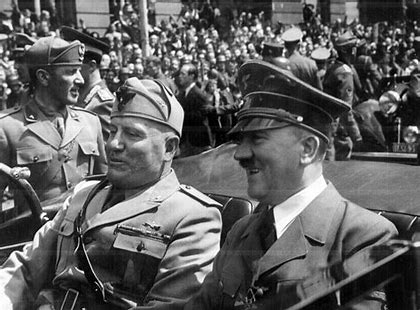
A growing number of astute political observers cite a global trend of authoritarianism since 1990. Countries like Russia, Turkey, India, Hungary and even the United States erode or effectively abolish democratic institutions and freedoms.  These observers – mainly scholars and journalists – situate authoritarianism in a historical context, often beginning with the Fascist leaders of the early 20th century – Italy’s Benito Mussolini and Nazi Germany’s Adolf Hitler and the Communist regimes of Stalin’s Russia and Mao Zedong in China. 

But what is authoritarianism?  How does it take hold of a polity?  How do authoritarian leaders gain and keep power?  Some people refer to these practices as an “Authoritarian playbook.” Of course, authoritarianism is not uniform. It varies in degrees of centralized power and brutality from Hitler and Stalin to Trump’s sustained efforts to erode democracy in the United States.  However, authoritarian leaders often borrow techniques from each other.  For instance, Hitler’s propaganda minister, Joseph Goebbels, travelled to Italy to study Mussolini’s methods to apply them to a rising Nazi Germany.  Donald Trump and his supporters echoed Victor Orban of Hungary’s conspiracy of billionaire George Soros as the leftist boogeyman and adapted Make Hungary Great Again to his MAGA mantra. As scholars like Ruth Ben-Ghiat and Jason Stanley point out, contemporary authoritarian tactics are not new but inspired by past authoritarian leaders.

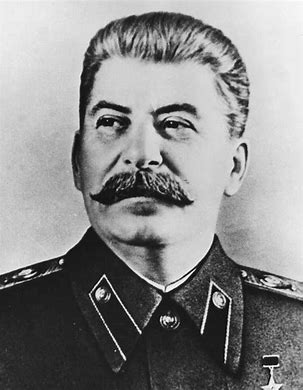
Soviet Leader Josef Stalin

Over the next year, we will publish blogs on authoritarian practices that some call the Authoritarian Playbook.  All writings will focus on the broader context, beginning with the post-WWI years, to explore similarities and crucial differences. 

Here is the list of upcoming topics.  

  1. What is Authoritarianism?  Historical interpretations.
  2. The Authoritarian Playbook: An Overview of Authoritarian Tactics
  3. The National Myth (Mythical Past)
  4. Us vs. Them: Fostering Division and Repression
  5. Attacking the Truth: Eroding Facts and Media credibility
  6. Re-education. Undermining Intellectual Challenges
  7. Undermining Checks and Balances (e.g. Judiciaries)
  8. Cult of Personality – “The Strongman”
  9. Corrupters and Enablers
  10. Using Violence
  11. Resistance and Downfall

Stay tuned for our first blog on authoritarianism – What is Authoritarianism?  Historical interpretations.

Bibliography

Ben-Ghiat, Ruth. Strongmen, From Mussolini to the Present.  New York: W.W. Norton and Company Inc., 2020.

Davis, Kenneth. Strongman: The Rise and Fall of Democracy. New York: Henry Holt and Company, 2020

Glasius, Marlies. (2018). What authoritarianism is and is not: A practice perspective. International Affairs. 94. 515-533. 10.1093/ia/iiy060.

Stanley, Jason.  How Fascism Works: The Politics of Us and Them. New York: Random House, 2018.

Britain and the Origins of the Industrial Revolution, Part 2: Population Growth and Improved Food Production

In Part 1 of our 7-part series on Britain and the origins of the Industrial Revolution, we introduced it as a time of gradual but fundamental change (transformation) in Britain from a dependency on organic resources and means of production to mechanized production using sources such as coal.  Along the way, Britain became more urbanized and expanded its markets domestically and internationally, becoming the world’s foremost power by the early to middle of the 19th century.  How did this happen?  What preconditions facilitated this transformation?   

Part 2 examines one of these preconditions: Improved Farming and Population Growth.

Improved farming and population growth provided essential preconditions for industrialization. Factory owners would need more people to grow their labour force and to buy their products.  More people required more food, and this growing demand hastened agricultural innovations that, in turn, facilitated population growth.  During the 17th century, farms gradually depended less on environmental whims and offered more predictable and productive yields.  Before these changes, people lived according to a traditional cycle of population and productivity.  When food production reached a limit based on available land and agricultural methods, the population reached a threshold, declined, and grew again until it reached production limits. This pattern stemmed from a system where agriculture involved subsistence for peasants and income for landlords and common lands were used for grazing livestock and fuel (e.g. wood).

Commercial Farming, Cash Crops and Enclosures

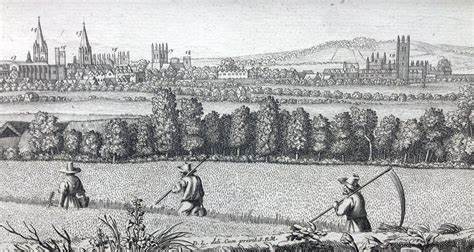
Various agricultural innovations drastically improved farm production and broke this cycle.  One fundamental change was the development of market-oriented agriculture. Landowners, mainly nobles, increasingly fenced off common lands to create land enclosures focused on growing cash crops for sale and export rather than local consumption. Governments, who sought noble support and tax revenues, supported these measures against peasant resistance – sometimes with armed forces.  This displaced peasants and many became wage earners on far or factories. 

Farmland enclosures

These cash crops created a greater demand for larger fields. Historian John Merriman writes, “Between 1750 and 1850 in Britain, 6 million acres – or one-fourth of the country’s cultivatable land – were incorporated into larger farms. (518)  The trend toward commercial agriculture was well on its way.

Farming Innovations: Crop Rotation and Animal Husbandry

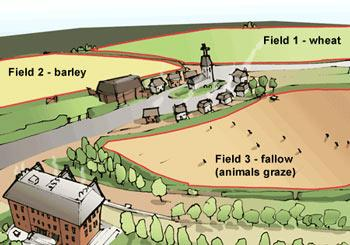
As farming became more commercialized, farmers became more specialized and adopted practices such as crop rotation.  Crop rotation differed from conventional agriculture, which saw farmers plant the same crop in the same place every year while leaving some fields fallow for two or three years to replenish their nutrients. Problems arose as these crops drew the same nutrients out of the soil, thus depleting it. Moreover, pests and diseases could establish themselves more readily.  Crop rotation addressed these problems.  Planting different crops sequentially on the same land optimizes soil nutrients and helps prevent pests and weed infestations. For instance, a farmer might plant corn one season and beans the next. 

Crop rotation

Healthy soil and healthy crops drastically improved food production.  Innovators like Robert Bakewell (1725-1795) improved animal husbandry, enhancing food supplies – particularly protein. 

Technological Advances

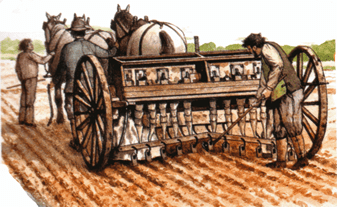
Technological advances also increased productivity. Farmer Jethro Tull (1674-1741) created the seed drill that planted seeds in deep soil, a drastic improvement over simply casting seeds on or near the surface where they would be more vulnerable to the elements or animals. Iron plows allowed farmers to turn the soil more deeply.

The seed drill.

Charles “Turnip” Townsend (1674-1738) learned how to cultivate sandy soil with fertilizer from the Dutch and expanded arable lands (Kagan 495).

More production and more food options.

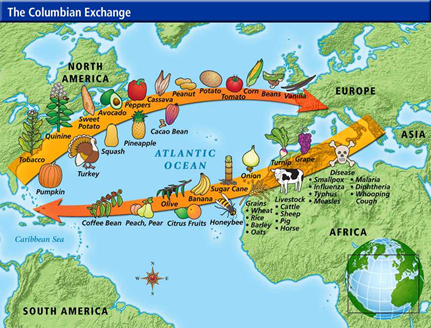
Throughout the next century, these farming innovations meant fewer people could produce more food, and more food could be grown per acre.  Improved food production also created more varied and calorie-rich diets –fundamental contributors to population growth.  The potato and maize – two nutritious foods from the Americas played essential roles.  Imported from the Americas, the potato became especially widespread throughout Europe.  Donald Kagan writes, “On a single acre, a peasant family could grow enough potatoes for an entire year. (Kagan, 497).  These local developments were bolstered by what Alfred Crosby called the “Columbian Exchange” – the exchange of food, animals, and disease between Europe and the Americas—from this, Europe gained maize, potatoes, sweet potatoes, and cod.  Indentured servants and slaves – laboured to produce these essential foodstuffs. 

Overall, production rates soared. Merriman points out, “England produced almost three times more grain in the 1830s than the previous century.” (Merriman 518) Besides feeding more people, farms produced more fodder for livestock and helped create a more reliable milk and meat source. More livestock also meant more fertilizer (manure).  Fish like the cod harvested off Canada’s east coast offered another protein source. 

Nutrition, Sanitation and Disease

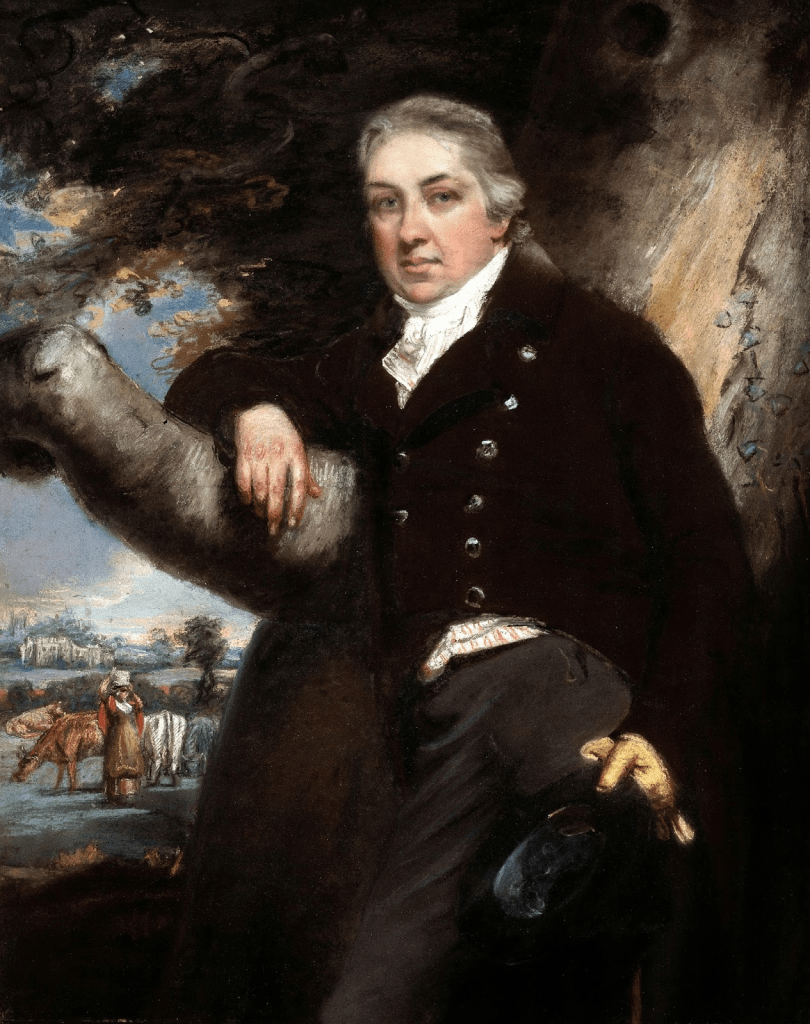
Better nutrition went hand in hand with improved disease prevention and treatment. Diseases like tuberculosis, influenza and dysentery still took many lives but conditions generally improved as cities gradually improved water supplies and waste management.  Medical practices only played a minor role until well into the 19th century. However, Edward Jenner’s vaccines for smallpox in the 1790s helped contain lethal outbreaks, and vaccinations would help stave off other diseases in the next century.  

Edward Jenner (1749-1823)

Rapid Population Growth

Over the eighteenth century the turn of the century, the population of England and Wales increased from about 5.5. million to approximately 10 million and 20.9 million by 1850.  (Cipolla, 29)   Growing numbers in urban centers like Manchester provided cheaper labour for factories to flourish.  Moreover, the combined factors of population growth and increased income per head led to more purchasing power and growing demand for products – – two essential factors for industrial growth.   

 Stay tuned for our next blog in our 7-part series on the origins of the Industrial Revolution in Britain.

Part 3: Access to Foreign Markets and Capital Investment

Britain and the Origins of the Industrial Revolution – Part 1.

The Industrial Revolution marks the most fundamental transformation of human life in the history of the human life in the history of the world recorded in human documents. Eric Hobsbawm

The mid-18th century to the first decade of the 20th century brought fundamental changes in people’s lives and thoughts.  During this time, Western Europe changed from a mainly agricultural region to an industrial one. These changes began in Britain and then spread to Western Europe and the U.S.  Russia, East Europe, and the Balkans came later.  The Industrial Revolution, as this period is called, is considered by many historians to be the most significant development in human history.  It involved, among other things, the creation of new technologies and economic systems as populations shifted from farms and villages to cities. Political systems, economic exchange, social relations, and warfare underwent drastic transformations.  New words like factory, railroad, middle class, capitalism, science, and engineers shaped how people saw themselves and their world (Winks 65).  How did this revolution begin, and how did it fundamentally change human life?  Why did it begin in Western Europe and, more particularly, Britain? 

In this 7-part series of blogs, we will examine the following:

Part 1: Introduction: Defining the Industrial Revolution

Part 2: Population Growth and Improved Food Production

Part 3: Access to Foreign Markets and Capital Investment

Part 4: A (Pre-mechanized Factory) Domestic Manufacturing Economy

Part 5: Technology, the Mechanization of Production and Alternative Sources of Energy (e.g. coal)

Part 6: Land and Water Transport

Part 7: The Textile Industry. 

Defining the “Industrial Revolution”

Scholars continue to debate various aspects of the Industrial Revolution. Even the chronology poses fundamental challenges.  Historian Lindeman writes that the Industrial Revolution offers “no easily identifiable beginning and no discernible end. (Lindeman, 44). Some scholars identify the beginning as the mid-eighteenth century.  Others, like R.C. Allen, go back to the 16th century. 

Considering the topic’s complexity, we need to define our terms.  “Industry” refers to the large-scale processing of raw materials and manufacturing goods in factories. “Revolution” is more problematic as it offers multiple meanings.  In one sense, revolution can be sudden, radical or change.  Historical examples include the French and American Revolutions that fomented sudden political and social change. However, “revolution” also refers to fundamental change. This might be political and socioeconomic change or ways of thinking, such as the Copernican revolution that revealed the Sun (rather than Earth) as the center of the universe or Darwin’s work on evolution.  Such events virtually pervade all aspects of human life, altering how we think and interact with the world.  This certainly applies to the Industrial Revolution.    

Although timelines are still debated, historians agree that the revolution was not sudden but occurred over a long period (150 years or longer), so they focus more on “revolution” as a fundamental change over time.  Donald Kagan writes that the Industrial Revolution “was revolutionary less in its speed, which was on the whole rate slow, than its implications for future of European society.” (Kagan 497) R.C. Allen writes that the Industrial Revolution “is no longer the abrupt discontinuity that its name suggests, for it was the result of an economic expansion that started in the sixteenth century.” (2). Accordingly, some scholars refer to an Industrial Evolution.

Of course, this extended period saw a profound change. The Industrial Revolution, Eric Hobsbawm points out, “was not merely an acceleration of economic growth, but an acceleration of growth because of, and through, economic and social transformation.” (13). The operative word here is transformation.   

What changed?

So, what was this “transformation” or “fundamental change?  One answer is that the Industrial Revolution altered a world ultimately dependent on the earth’s resources and organic means of production – dependencies that limited growth. Food production, for instance, involved people and animals toiling in fields, their productivity limited by land availability and technological limits.  Watermills used water flow but required proximity to a river.  Wind-propelled ships and windmills depended on the wind.  People burned wood to cook, heat homes, and metallurgy this but required access to trees – a rapidly dwindling European resource.  At the beginning of the 1700s, more than 90 percent of the European population lived in rural settings and engaged directly in animal husbandry and agricultural activities.” (MIII, 301) Few urban dwellers worked in factories. 

All of this would change – albeit gradually and in the beginning, only in particular parts of the world. Over time the focus on organic labour and agriculture shifted to alternative sources of energy -especially coal – and the factory-based and mechanized production of goods. (MIII,296) To better understand how this transformation happened, we must explore the preconditions that facilitated these changes. It all began in Britain.

So, this series of blogs will focus on the factors that led to Britain’s gradual transformation into the world’s first industrial nation.

Our next blog: Part 2 Population Growth and Improved Food Production

Bibliography

Allen, Robert. 1994. “Agriculture During the Industrial Revolution, 1700-1850.” In Roderick Floud and Donald N. McCloskey, eds., The Economic History of Britain Since 1700. 2d ed. Cambridge: Cambridge University Press, Vol. I. Ashton,

Allen, R. C. (1999). Tracking the Agricultural Revolution in England. The Economic History Review, 52(2), 209–235. https://doi.org/10.2307/2599937

Allen, R. C. “Why the Industrial Revolution Was British: Commerce, Induced Invention, and the Scientific Revolution.” The Economic History Review 64, no. 2 2011: 357–84. http://www.jstor.org/stable/41262428.

Cardwell, D.S.L. 1994. The Fontana History of Technology. London: Fontana. Crafts,

Cipolla, Carol M. The Fontana Economic History of Europe: Vol. 3, The Industrial Revolution. London: 1973.

Hobsbawm, Eric. Industry and Empire: The Birth of the Industrial Revolution. New York: The New Press, 1999.

Kagan, Donald.   The Western Heritage. Toronto: Pearson Education LTD., 2007.

Komlos, John. “Nutrition, Population Growth, and the Industrial Revolution in England.” Social Science History 14, no. 1 1990: 69–91. https://doi.org/10.2307/1171364.

Landis, David S. The Wealth and Poverty of Nations: Why Some are so Rich, and Some are so Poor. New York: W.W. Norton and Company, 1999.

Marks, Robert B. The Origins of the Modern World: A Global and Biological Narrative from the Fifteenth to the Twenty-first Century. Lanham, Maryland: Bowman and Littlefield Publishers, Inc. 

McCloskey, D. N. 198-. “The Industrial Revolution in Britain 1780- 1860: A Survey,” in Roderick Floud and Donald McCloskey, The Economic History of Britain since 1700.

Merriman, John. A History of Modern Europe: From the French Revolution to the Present. Volume Two. New York: W.W. Norton and Company, 2010. 

O’Brien, P. K. “Agriculture and the Industrial Revolution.” The Economic History Review 30, no. 1 1977: 166–81. https://doi.org/10.2307/2595506.

Osbourne, Roger. Iron, Steam, and Money: The Making of the Industrial Revolution. London: Random House, 2013.

Pelz, William A. “Becoming an Appendage to the Machine: The Revolution in Production.” In A People’s History of Modern Europe, 52–63. Pluto Press, 2016. http://www.jstor.org/stable/j.ctt1c2crfj.9.

Schellekens, Jona. “Nuptiality during the First Industrial Revolution in England: Explanations.” The Journal of Interdisciplinary History 27, no. 4 1997: 637–54. https://doi.org/10.2307/206538.

Vries, Peer. (2008). The Industrial Revolution. Pdf file downloaded

Winks, Robin and Joan Neuberger. Europe and the Making of Modernity, 1815-1914. New York: Oxford University Press, 2005. 

Disease and European Expansion to the Americas 

After Christopher Columbus landed in San Salvador in 1492, Europeans settled and eventually conquered the Americas. How did Europeans overwhelm an Indigenous population that scholars have estimated to be between 60 and 100 million? An essential factor involves the drastic population decrease of Native Americans over the following two centuries. The estimated numbers are staggering, ranging between 70 to 95%!

Scholars cite numerous reasons for this devastation, including superior European technology (e.g., weapons), brutal European tactics, and disease.  Of these factors, diseases carried by Europeans stand as the main culprit of the Native American decimation. Europeans also succumbed to illness but not nearly to the extent of the Indigenous population.

Why did the exchange of germs between Europeans and Native Americans lead to such lopsided results? What gave Europeans a more resilient immune system? To find answers, we need to venture back thousands of years.

Farming and Livestock. Scholars like Alfred Crosby and Jared Diamond argue that Europe’s biological advantage stemmed from the Agricultural Revolution that scholars estimate began c 8000 BC. This gradual transition from hunting and gathering to farming led to significant changes that would facilitate European expansion many centuries later.

Two overarching factors come into play. The first is the domestication of diverse animal species. Alfred Crosby points out that the Old World domesticated a wider range of animals than New World communities. Compare, he writes, “the American assemblage of livestock (dog, lamas, guinea pigs, and some fowl), with that of the Old World: (dogs, cats, cattle, horses, pigs, sheep, goat, reindeer, water buffalo, chickens, geese, ducks, horses and more.” (19)

Ancient Sumerians (c4500-1900BC), residing in the southern part of Mesopotamia, in the flatlands between the Tigris and Euphrates rivers (now south-central Iraq), stood as the eminent domesticators of animals in their time. Animal power allowed people to farm more land than human muscle could muster. Livestock provided a consistent food source – meat and milk – essential during poor cop seasons. Both factors yielded more food, more surplus and facilitated population growth.

More livestock also meant more interspecies exchange of a broader range of microbes. Animals and people died or became quite sick, but sustained contact gradually led to immunity to a comprehensive range of diseases. Smallpox, the flu, influenza, measles, and other ailments evolved from human and livestock interactions. Poxviruses, Crosby points out by way of example, “oscillated back and forth between humans and cattle to produce smallpox and cowpox.” (Crosby, 31) 

Population and “Crowd Disease” Secondly, higher and denser populations exacerbated this interplay of livestock and human. As technologies improved, more people (and animals) could live in smaller areas and encouraged greater microbial spread. The rise of cities further encouraged the spread of germs. More people breathe the same air, spend more time in proximity and are more likely to contact human waste and disease carriers like rodents and insects that thrived in dense human populations.

Of course, these increasingly immunized people from cities and large villages did not stay put. Sumerians and subsequent civilizations traded, travelled, moved, and fought battles and wars, leading to contact with other peoples, including hunter-gathers who lacked sophisticated immune systems. 

Centuries later, when Columbus reached the Americas, Europeans had developed an incredibly resilient immune system that could withstand the likes of smallpox, yellow fever, diphtheria, influenza, chickenpox, and a host of other diseases bred over centuries. Native Americans lacked the immune systems to cope with the microbial onslaught. American populations, new studies show, were higher and denser than previously assumed but still not comparable to European ones. As previously mentioned, a less diverse American livestock inventory meant a narrower field of microbial exchange.  

Disease alone did not decimate America’s Indigenous population, but it seems to be the main culprit. “Far more Americans died,” Jared Diamond writes, “in bed from European germs than on the battlefield from European guns and swords.” (201). Other factors certain exacerbated their impact. Thomas Benjamin points out that diseases “were accompanied and made more deadly by war, exploitation, slavery, and missionaries who brought dispersed people together in a large community.” (321). We must also note that diseases did not uniformly impact the Americas. Denser and higher populations saw higher mortalities. Some Native communities in the northern reaches of Canada did not feel the impact of Old World disease until the 19th and 20th centuries.    

Scholars still debate the topics such as population numbers and whether Europeans, at times, intentionally infected Native people. However, there is a growing consensus that Old World diseases led to the European conquest of the Americas more than any other factor. 

Glossary

Columbian Exchange. Alfred Crosby coined this term to describe the transcontinental transport and exchange of plants, animals, and diseases. 

Crowd Disease. A disease that can only be exchanged from person to person and therefore thrive in crowded populations.

Influenza. Flu, contagious respiratory disease.

Measles. A viral disease marked by red spots on the skin.

Microbes. A microorganism. Often referring to bacterium causing disease.

Pathogen. An agent that causes disease.

Smallpox. Viral disease became more virulent during the Renaissance (coinciding with Columbus’s voyage to the Americas). Arguably the most devasting disease to Native Americans. 

Selected Bibliography.

Benjamin, Thomas. The Atlantic World: Europeans, Africans, Indians, and Their Shared History, 1400-1900. New York: Cambridge University Press, 2009.

Crawford, Dorothy H. Deadly Companions: How Microbes Shaped our History. Oxford: Oxford University Press, 2017.

Crosby, Alfred W. Ecological Imperialism: The Biological Expansion of Europe, 900-1900. New Edition. New York: Cambridge University Press, 2004.

Diamond, Jared. Guns, Germs, and Steel. The Fates of Human Societies. New York: W.W. Norton and Company, 2017.

Hopkins, Donald R.  The Greatest Killer: Smallpox in History. Chicago: University of Chicago Press, 2002.

Kiple, Kenneth F. ed. The Cambridge World History of Human Disease. Cambridge: Cambridge University Press, 1993.

Martin, Charles. A Short History of Disease: Plagues, Poxes and Civilizations. Harpenden, Herts: Pocket Essentials, 2015. 

Watts, Sheldon. Epidemics and History: Disease, Power, and Imperialism. New Haven: Yale University Press, 1997.

Germans and the Nazi Persecutions (1933-45): Coercion or Complicity?

Complicity. Partnership in a crime or wrongdoing.

Coercion. Persuade or restrain (an unwilling person) by force or threat of punishment.

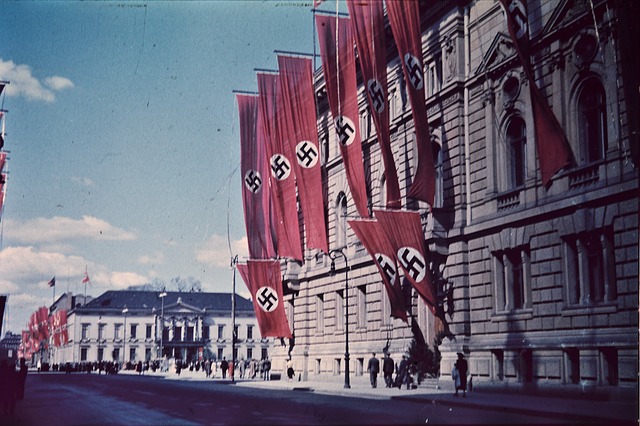
Introduction. Adolf Hitler and the National Socialist Party gained power in 1933 and would govern Germany until the end of World War Two (1945). By 1934, his Nazi government had become a dictatorship, with Hitler as the Fuhrer. With bolstered state powers, they persecuted  “enemies of Germany,” such as Communist Party members, Social Democrats, and labour groups. Hitler also targeted those deemed unfit according to the Nazi racial hygiene agenda – people of colour, gypsies, criminals, the mentally and physically challenged and above all, Jews. The Nazis dismissed people from their jobs, confiscated property, locked people in prisons and concentration camps, sterilized the “unfit,” and executed millions. 

A Debate. How was it possible for the Nazis to persecute various groups – especially- Jews without significant resistance from German citizens? Many historians have addressed this question. Some scholars argue that German citizens complied with and supported and even initiated the persecution and slaughter of Jews and other groups. Others insist that most Germans disapproved of Nazi domestic persecution and terror but did not speak out for fear of Nazi retribution, including loss of property or career, imprisonment, and execution. 

Nazi Terror and Retribution. When Hitler and the National Socialist Party took power in 1933, they began centralizing control of Germany. According to Richard Evans, the main instrument of coercion was the law. The Nazis passed laws and decrees that broadened what constituted treason and people’s options for freedom of expression. For instance, it became legal to ridicule Hitler, to make derogatory remarks against the Nazi party, or to “discuss alternatives to the political status quo.” (Evans,101)  

Speaking out against Nazi policies or assisting the persecuted could result in severe retribution. In Why? Explaining the Holocaust (2017),  Peter Hayes points out that “overt assistance to Jews constituted sabotage punishable by death”  and cites the example of Nazi Anton Schmidt, who facilitated the escape of at least 100 Jews after witnessing the execution of Jewish infants. After being exposed, he was court-martialed and executed. (145-146).   

Surveillance and intimidation proved effective deterrents to dissent. The Nazi secret police (Gestapo) did not have many men at their disposal but still “infiltrated people’s lives – directly, indirectly and psychologically.”  (Childress, 319).   Gestapo agents performed late-night arrests and interrogations. Germans were encouraged to report transgressions of Nazi law by their peers, neighbours and even family. Those charged faced a dubious legal process through what Richard Evans describes as a “whole system of regional Special Courts, crowned by the National People’s Court, the Volkgerichlen, was created to implement these and similar laws. (Evans, 101)

These historians argue that the Nazis organized an effective program of intimidation and coercion that effectively discouraged Germans from resisting the Nazi racial hygiene program.  

Citizen Complicity. Other scholars believe such interpretations overstate the extent of Nazi control while neglecting the willingness of German citizens to facilitate and even initiate the persecutions. In Hitler’s Willing Executioners: Ordinary Germans and the Holocaust (1997), Daniel Goldhagen acknowledges Nazi government coercion but argues that the main driving force behind the Holocaust was deep-seated, specifically German antisemitism.  

Goldhagen relates a story about Captain Wolfgang Hoffman, “a zealous executioner of Jews” who led “ordinary men” to slaughter tens of thousands of Jews in Poland. (3). Hoffman, he points out, refused to sign a declaration that his group would not plunder and steal from the persecuted Jews. Why did he refuse? Hoffman took offence that he and the men under his charge would steal. Besides the irony that Hoffman enthusiastically killed people, Goldhagen points out that Hoffman was not punished for refusing a direct order. In order words, Hoffman had a choice. By extension, his persecution of Jews came not from fear of retribution but from personal conviction—a willing executioner. 

Goldhagen goes on to argue that historians have focused on the leaders of the Nazi regime while neglecting people like Hoffman who facilitated the execution not from fear of Nazi retribution but out of a conviction that stemmed from “a particular type of antisemitism that led them to conclude that the Jews ought to die.”

Goldhagen’s thesis hinges on pervasive  German-specific antisemitism – a point of controversy among historians.   In Hitler and the Holocaust (2001), Robert S. Wistrich argues that Goldhagen overstates the role of German eliminationist antisemitism in the Holocaust. Germans certainly facilitated the killings, but this didn’t stem from a longstanding eliminationist mindset in the mid 19th century. Before Hitler, Wistrich argues, “racist antisemitism had not made great inroads in Germany” and was “still a state based on the rule of law, where Jews achieved remarkable economic success, were well integrated into society, and enjoyed equal rights.” (4)  

Selective Nazi Terror. In Nazi Terror: The Gestapo, Jews and Ordinary Germans (1999), Eric Johnson agrees with Goldhagen that many ordinary Germans willingly facilitated terror campaigns, persecutions and genocide. He also acknowledges the role of Nazi coercion but disagrees with Evans on the extent of Nazi coercion. He argues that Hitler’s government did not terrorize most Germans but instead focused the terror against “enemies of the state” – especially Jews. Most German citizens were not directly impacted by Nazi terror and “enjoyed considerable space to vent their everyday frustration with Nazi policies and leaders without inordinate fear of arrest or prosecution. (19)

Richard Evans disagrees with Johnson’s presentation of selective Nazi coercion and persecution. Nazi violence focused more on particular groups but “operated across the board.”(199). In 1933-4, for instance, the Nazis targeted the political leaders of the Social Democratic and Communist parties, such as Social Democrat Johann Steller, who “was tortured to death. (93).   Together, Evans notes, “the Social Democrats and Communists had won 131 million votes in the Reichstag election of 1932.” (94). “Hardly,” he points out, “members of a despised minority of social outcasts.”(94)

Self Interest and Opportunism Another historian who does not see antisemitism as the main factor in Holocaust is Joseph D. Bendersky. In A Concise History of Nazi Germany (2014), Bendersky argues that “the Jewish question had not been important to most German” who were more concerned with “moral degeneracy, crime, political subversion, and public order.” (139). Accordingly, the persecution of Communists, sexual deviants, and violent criminals received public support. He places more weight on other factors, including economic self-interest and the “terror of the police state.” (141)  Regarding self-interest, Bendersky notes how although a “Large segment” of German were shocked by Nazi violence, many opportunistically filled the Jewish vacancies in various professions, civil service positions, and businesses as Nazis pushed Jews out of their jobs. “Profit at the expense of the Jews was a temptation too many could not resist.” (139). Like Evans and Hayes, he adds that the Nazi use of terror deterred resistance and many who persisted paid the price. “Countless individuals,” Bendersky writes, paid with their lives for speaking out or for attempting to save others from Nazi tyranny. (141)

Conclusion. The role of German citizens in Nazi persecution, and particularly the Holocaust, remains a contentious topic and one that scholars will grapple with for many years to come. Hitler’s Nazi regime indeed used terror and reward to encourage German complicity. Some Germans, of course, engaged in the persecutions of “German enemies” with horrific enthusiasm. The longstanding question remains. Which factored more, coercion or complicity?

Bibliography

Aly Gotz, Peter Chrousti and Christine Ross. Cleansing the Fatherland: Nazi Medicine and Racial Hygiene. Baltimore: Johns Hopkins University Press, 1994.

Barnet, Victoria J. Bystander: Conscience and Complicity During the Holocaust. Westport, CT: Praeger, 1999

Bendersky, Joseph W. A Concise History of Nazi Germany. New York: Rowman and Littlefield Publishers, Inc. 2014.

Benz, Wolfgang. A Concise History of the Third Reich. Berkeley: University of California Press, 2006

Bergen, Doris L.  Twisted Cross. The German Christian Movement in the Third Reich. Chapel Hill, 1996.

Childress, Thomas. The Third Reich. A History of Nazi Germany. New York: Simon Shuster, 2017.

Marc Dewey, Udo Schagen, Wolfgang U. Eckart & Eva Schoenenberger, “Ernst Ferdinand Sauerbruch and His Ambiguous Role in the Period of National Socialism”, in Annals of Surgery 244 (2006), pp. 315- 321.

Friedlander, Saul. Nazi Germany and the Jews, Vol. 1 The Years of Persecution, 1933-1939. New York: 1997.

Goldhagen, Daniel Jonah.  Hitler’s Willing Executioners. Ordinary Germans and the Holocaust. New York: Random House Inc., 1997.  

Hamerow, Theodore S. On the Road to the Wolf’s Lair. German Resistance to Hitler. London, 1999

Hayes, Peter. Why? Explaining the Holocaust. New York: W.W. Norton Inc. 2017.

Johnson, Eric A. Nazi Terror: The Gestapo, Jews, and Ordinary Germans. New York: Basic Books, 1999.

Lifton, Robert J. The Nazi Doctors: Medical Killing and the Psychology of Genocide. New York, 1986.

Kershaw, Ian. The Nazi Dictators: Problems and Perspectives of Interpretation. (London, 1993).

Proctor, Robert N. Racial Hygiene: Medicine Under the Nazis. Cambridge MA: Harvard University Press, 1998. 

Schmidt. U.H. Karl Brandt: The Nazi Doctor. New York: Continuum, 2007

Shirer, William. The Rise and Fall of the Third Reich. New York: Simon and Shuster, 1960.

Stern, Fritz. Five Germans I have Known. New York: Farar, Straus, and Giroux, 2006. 

Thomas, Gordon and Gary Lewis. Defying Hitler: The German Who Resisted Nazi Rule. New York: Random House, 2019. 

Wistrich, Robert S. Hitler and the Holocaust. London, The Orion Publishing Group, 2001. 

Wistrich, Robert. Who’s Who in Nazi Germany. London, 1995.