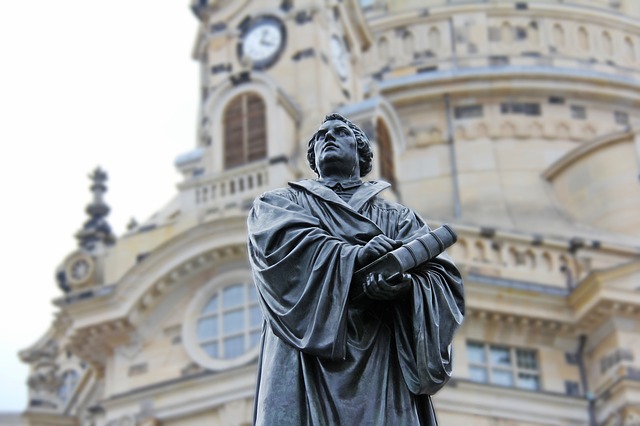
Martin Luther and the Protestant Reformation

 For we hold that a man is justified by faith alone, apart from the works of manMartin Luther

Historians are clear about the far-reaching impact of what came to be known as the Protestant Revolution that began in the 16th century CE.  J.M. Roberts describes it as “the great crisis which shook western Christianity and destroyed the old medieval unity of the faith in the early sixteenth century forever.” (538). At one point, the Catholic Church, headed by the Holy Roman Empire, offered a unified vision of the world and the afterlife.  This consensus changed with the Protestant Reformation lead by the determined and articulate Martin Luther (1483-1546).    

The Holy Roman Empire and Catholic Reform. The Holy Roman Empire arose from a desire to create a Christian version of the Roman Empire in the West and a counterweight to the Byzantine Empire in the East. Ultimate authority resided with the Pope and the Holy Roman Emperor, who often vied for supreme power.  Together they faced many threats to Catholic unity – the rise of nation-states, nationalism from Germany and other states, religious wars, debt, and an increasingly evident corruption among clerical ranks- that encouraged dissent and calls for reform. 

Calls for reform did not begin with Martin Luther.  As J.M. Roberts writes, “The fifteenth century had been marked by a deep, uneasy devotional swell: there had been a sense of looking for new answers to spiritual questions, and of looking for the outside the limits laid down by ecclesiastical authority. (536)  Peasant revolts against clerical authority erupted in various parts of Europe.  Jan Hus (1372-1415) and other religious reformers spoke against church corruption and control over spiritual practices.  Devout Catholic and Christian humanist Desiderius Erasmus criticized clerical corruption and called for more inward Catholic worship and abandoning Catholic traditions such as confessions and sacraments.  He also criticized clerical corruption. 

Rome, of course, did not welcome criticism and censored public opinion – a task increasingly difficult with the advent of the printing press in c 1440.  In 1501, Rome issued a papal bull ordering the burning of all books questioning church authority.   Rome also forbid the printing of books without church approval. Criticism of the papacy could lead to Imprisonment and execution.  After being excommunicated and receiving a Papal Bull, Rome executed an unrepentant Jan Huss for refusing to recant his calls for reform.  Speaking out against the Roman Catholic Church required courage and conviction.  Martin Luther, a relatively unknown scholar in Wittenberg, Germany, had an abundance of both qualities. 

Martin Luther (1483-1546). Martin Luther became a monk in 1505, then professor of Theology at Wittenberg, Germany. Rigorous biblical studies lead him to interpretations that differed from accepted Catholic beliefs, especially around salvation. Catholic doctrine advocated that salvation could be gained through faith and good works, particularly the Catholic practice of sacraments.  Luther disagreed.  Salvation, he insisted, could only be granted by God. Efforts to achieve his grace through penance and good works were misguided and futile.  Human actions could not persuade God. 

As a devout Catholic, Luther did not want to split the Church.  His conviction challenged the penitential system fundamental to Catholic belief and practice and undermined Rome’s long-reaching authority. As it stood, he kept his challenge relatively private.  It would take, writes Thomas Cahill, “the prompting of an unusually shameless and aggressive display of ecclesiastical corruption to prompt Luther into the public challenge.  (147).   

Rome offered such a display. 

A Prompting. In 1515, Pope Leo X authorized the sale of indulgences, paper certificates granting salvation.  Roman officials travelled Europe collecting funds from those wanting to avoid purgatory. They found many buyers, and indulgences became a significant source of revenue for a papacy under financial strain from ongoing wars, patronage, and building projects, most notably St. Peter’s Basilica.

For Luther, the sale of indulgences itself was misguided.  How officials, in particular Johann Tetzel, sold them intensified his ire.  Tetzel, a German Dominican monk, sold Indulgences in Germany with zeal and style, using the slogan “As soon as the coin in the coffer rings, the soul from purgatory springs.”  William Manchester describes the monk as “a sort of medieval P.T Barnum.” (134). Disgusted, Luther set about writing a series of theses criticizing the sale of indulgences and set in motion a series of events that would Christendom in Europe.

95 Theses on the Power and Efficacy of Indulgences In 1517, some historians alleged, Luther posted his 95 Theses on the Power and Efficacy of Indulgences on the church wall in Wittenberg. Others like Thomas Cahill maintain that Luther sent his theses, accompanied by a very respectable letter to Archbishop Albrecht, who passed it along to Rome.  (p?)  Either way, Luther directly challenged Catholic doctrine and the Pope himself.  Luther did take direct aim at Pope Leo X, saying if the Pope could grant salvation, he could offer it for free or even give indulgence revenues to the poor.  It was a direct challenge to papal authority and a condemnation of a vital income stream for a debt-ridden Rome. 

Spreading The Word. Luther’s protests spread quickly.  Printers (without Luther’s permission) circulated thousands of copies of his theses, including many in German. Most people could not read, but those who could verbally spread his critique of indulgences, striking a nerve with people already resentful of Rome’s extensive authority and blatant corruption.  Some saw opportunities.  For German princes, a reduced papal presence in German lands meant more independence and even access to Church lands.   

 Luther followed up his theses with three pamphlets that further criticized the system of sacraments. He also argued that priests should marry and encouraged translating the Bible into languages like German to allow people a more direct relationship with sole authority.   Luther was on a roll. 

Rome Responds. His protests reached Rome, who demanded he recants his statements.  When Luther refused, they charged Luther with heresy.  Pope Leo X considered summoning Luther to Rome, but Frederick the III intervened.  Knowing Luther might not return from Rome, Frederick convinced the Pope to have Luther state his case in front of the Diet of Worms (a deliberative assembly of the Holy Roman Empire), presided over by the Holy Roman Emperor himself Charles V.  

Why did Frederick III protect Luther?  How could he persuade Leo X to allow Luther to present his case in Worms? Some historians have pointed to the growing anti-papal sentiment among Germans who sought more self-determination and less Roman taxes and political meddling.  Handing over Luther to Rome would be a sign of weakness and compliance.  Moreover, Frederick himself found Tetzel’s actions offensive and yet another example of Rome extracting money from his territory.  Ruling an increasingly nationalist and ani-Papal Saxony and holding an upcoming vote for the Holy Roman Emperor gave Frederick some clout.  Leo X conceded. 

Luther Answers to Rome. In 1521 Martin Luther presented his case in front of the Diet of Worms. Luther stood his ground, identifying the Bible as the only authority and defying officials to demonstrate contradictions between his theses and the Holy book.  A frustrated Charles V proclaimed him a heretic and forbade citizens to promote Luther’s ideas. Knowing Luther was in danger, Frederick III lobbied for Luther’s safe passage to Wittenberg hid him in Germany. 

Conclusion Luther avoided execution, and Rome could not stem the tide of protestant revolt.  Farmers, in particular, acted out violently.  Luther condemned these protests as going beyond the laity’s boundaries of obedience.  The demise of Christian unity also opened the way for new sects such as Calvinism, Anglicanism, and Anabaptism.  Rome actively implemented many reforms – collectively known as the Catholic Reformation- but would not regain Christian unity in Europe.  A series of religious wars during the last half of the 16th century hardened divisions throughout Christendom.  Eventually, religious pluralism became the norm in most countries.    

The Protestant Reformation is a convenient term for religious upheavals that were neither coordinated nor mutually supportive.  Moreover, it is difficult to pinpoint its origins.  As religious scholar Karen Armstrong points out, “we don’t know exactly why ‘the Reformation’ happened.  Many factors mingled together- nationalism in cities (especially Germany), the printing press, clerical corruption, a greater sense of individualism, and of course, Luther himself – to foment a movement that brought fundamental changes to Europe and the World. 

Selected Bibliography

Armstrong, Karen.  A History of God: The 4000 Year Quest of Judaism, Christianity, and Islam.  New York: Ballantine Books, 1993. 

Boorstin, Daniel J. The Seekers: The Story of Man’s Continuing Quest to Understand His World.  New York: Vintage Books, 1999. 

Cahill, Thomas.  Heretics and Heroes: How Renaissance Artists and Reformation Priests Created Our World.  New York: Anchor Books, 2013

Cooke, Tim. ed.  National Geographic Concise History of World Religions.  Washington D.C. National Geographic, 2011. 

Gonzalez, Justo L.  The Story of Christianity.  Volume 2.  New York: HarperCollins, 2017

Manchester, William. A World Only Lit By Fire: The Medieval Mind and the Renaissance.  New York: Little, Brown and Company, 1992. 

Roberts, J.M. The Penguin History of the World. London: Penguin Books, 1988

Spielvogel, Jackson J.  Western Civilization. Volume B: 1300-1815.  Boston: Wadsworth, 2012. 

Stearns, Peter L. World Civilization: The Global Experience. New York: Addison-Wesley Education Publishers, 2001.

World War 1 Begins

The Great War, also later known as World War 1, began in 1914 as a European conflict between the major powers and spread to almost all European states except Switzerland, Norway, Finland, Sweden, the Netherlands and Spain.  Countries outside of Europe like Canada, the United States, New Zealand, Japan, and India joined the fray, usually due to political obligations or strategic concerns.  Many believed the war would be short-lived. Fighting, however, lasted until 1918, taking many lives and forever changing the global landscape.

How did the war begin? The origins of the conflict are complex and contentious.  Historians have cited numerous causes, including the Alliance System, nationalism, imperialism and militarism. As eminent historian Jacques Barzun pointed out, “No conclusion has been agreed upon.” (68). We will explore the causes and other topics of The Great War in other blogs.  For now, we will focus on the events leading to war. 

European Alliances and Rivalries The alliance system refers to the two opposing camps that entered the war in 1914 after a series of war declarations.  On one side, the Triple Alliance comprised Germany, Italy, and Austria-Hungary.  The other, the Triple Entente, included France, Great Britain and Russia. These alliances reflected a “strength in numbers” approach to security.    

All of the countries had reasons to ally. France feared a Germany that, since its unification in 1870, became a formidable economic and military power, in part at France’s expense. During the Franco-Prussian War (1870-1), Prussia defeated France, annexed Alsace-Lorrain, and made France pay reparations.  An invigorated Germany bolstered its military power and, through French eyes, remained the primary threat.  Britain and Russia agreed.  Germany’s military growth, particularly its Navy, threatened Britain’s traditional naval hegemony.  Russia, still recovering from their 1905 loss to Japan and reeling from an internal revolution, saw a growing Germany as a threat to Russia’s western border.   

Germany, of course, had its concernsWith France and Russia on its west and east borders, Germany stood pinned between two powers. Berlin met this challenge in two ways. First, in 1880, German Chancellor Otto Von Bismark solicited Austro-Hungary and Italy to create a Triple Alliance. Second, they adopted the Schlieffen Plan – an offensive strategy where Germany would attack France first in the hope of defeating them before Russia mobilized – in what they estimated to be forty-two days. (Storey, 21-22) 

Berlin’s primary ally, Austria-Hungary, included a significant German population and coveted a solid supporter to back it against Balkan uprisings, particularly from Serbia.  Italy, less enthusiastic about allied commitments, would not enter the war until 1915 – alongside the Triple Entente of Britain, France, and Russia! Neither Russia nor France matched Germany’s economy or military, but together they offered a viable threat.  Neither Berlin nor Vienna wanted to stand alone. 

So, how did these countries come to war?

The Balkans – Instability Spreads. As William Kelleher Storey writes, the war  “was touched off by a crisis over nationalist aspirations in the Balkans,” a region of unrest and instability. (29)  The Ottoman Empire once controlled the Balkan Peninsula but, after a steady decline, relinquished control of the region that broke into several countries  – Serbia, Bulgaria, Bosnia, Herzegovina, Romania, Montenegro and Greece.   Competing nationalities and religions exacerbated political divisions and lead to perpetual struggles for regional control and independence, leading to many local conflicts and longstanding hostilities.

Serbia became the peninsula’s dominant country and took center stage leading to the Great War. Serbia gained independence from a weakening Ottoman Empire in 1878 and coveted a Greater Serbia.  Austria-Hungary feared Serbian nationalist fervour might encourage the southern Slavic population in Austro-Hungary to separate and join Serbia. 

On the other hand, Russia coveted a strong Serbia as a base of influence in the Balkans and Constantinople and the Dardanelles that would link the Black Sea and the Mediterranean.   These ambitions, coupled with its Slavic heritage, lead Russa to offer itself as sponsor and protector of the Slavs in the Balkans, particularly Serbia.  

Vienna’s annexation of Bosnia and its significant Serbian population in 1908 widened the rift between Austria-Hungary and Serbia.  Russia, still recovering from its 1905 loss to Japan and warned off by Germany, did not intervene, undermining its status as Slavic protector.  As tension grew between Serbia and Austria-Hungary, it seemed more likely that regional strife would spill over into the rest of Europe.  All that was needed was a catalyst – that occurred on July 14th, 1914. 

The Catalyst. On July 14th, 1914, Serbian nationalist Gavril Princip assassinated Austro-Hungary’s Archduke Franz Ferdinand and his wife- shooting them both in the car as they toured the streets of Sarajevo.   Emboldened by German support, Austria issued an ultimatum to Serbia that would effectively deny Serbian independence.  Serbia accepted all but one of the demands.  Seeing an opportunity to deal with the “Serbia problem,” Austria-Hungary declared war on Serbia on July 28th.  

The entangled alliances and competing interests encouraged a series of Great Power decisions that lead to a much broader conflict.  Here is a very simplified sequence of events. Russia, supporting Slavic Serbia and protecting its influence in the Balkans, declared war on Austria-Hungary and mobilized its forces.  Germany, alarmed by Russian mobilization and in support of Vienna, declared war on Russia then France.  Germany’s attack plan on France required them to cross Belgium, a neutral country.  This action leads to Britain, obligated to protect Belgian neutrality, to declare war on Germany.  Now, the prominent European nations were at war, and soon, soldiers from around the world would join the fray. 

Conclusion. Could the war have been averted?  Some historians insist that the alliance system meant that one declaration of war leads to the diplomatic equivalent of dominoes falling.  Others maintain that leaders could have made different choices and averted war.  These are discussions for future blogs.  Historians, however, do agree that World War 1, drastically changed Europe and the world. 

Selected Bibliography

Barzun, Jacques.  From Dawn to Decadence, 1500 to the Present: 500 Years of Western Cultural Life.  New York: Harper Collins, 2000.

Black, Jeremy.  The Great War and the Making of the Modern World.  London: Continuum International Public Group, 2011. 

Davies, Norman. Europe: A History.  London: Oxford University Press, 1997. 

Ferguson, Neill.  The War of the World Twentieth Century and Descent of the West.  Penguin Books, 2006. 

Meyer, G.T. A World Undone: The Story of the Great War, 1914-1918.  New York: Bantam Dell, 2006. 

Roberts, J.M.  The Penguin History of the World.  New York: Penguin Books, 1987.

Storey, William Kelleher.  The First World War.  London: Rowman and Littlefield, 2014.

Europe and The Black Death: An Introduction (1347-51)

In 1347, a merchant ship landed on the shores of Italy, harbouring a plague that would wipe out twenty-five to fifty percent of Europe’s population over the next three years.  Historians later referred to these plagues as the Black Death, the most devastating natural disaster in European history.

What was the Black Death? How did it spread so far and so quickly?  How did people react to the destruction it wrought? We will address these questions in the broadest sense, focusing on the European context.  We will address the plagues’ impact on different parts of the world, its short and long-term impact and other aspects in other blogs.  For now, let’s explore what happened in Europe. 

What was The Black Death? How did people get infected?Norman Davies aptly described the Black Death as a “devastating brew of three related diseases – bubonic plague, septicaemic plague, and pneumonic plague. (Davies, 409)  The most common, the bubonic plague – Yersinia pestis – often resided in rats.  Humans became infected when fleas bit rats then bit humans.  Symptoms included bleeding under the skin, swelling of the lymph nodes, delirium and fever. The hardest hit were children, the sickly, and the elderly. Still, the plagues did not discriminate, readily killing off kings, queens, the aristocracy – everyone. 

Origins. How did it Spread? Historians estimate the pandemic originated in Central Asia in the 1330s, first infecting the Mongols who controlled many trades and travel routes.  Rats accompanied the Mongols, and merchant travellers along land and water routes in the early 1300s spreading the disease to faraway places.  By 1347 it reached Constantinople.  Egypt became infected a year later.   That same year it reached Europe when a Genoese merchant brought it from Caffer to Sicily. It spread into southern France and Spain, Germany, France and the Low countries and England by 1348.   Eastern Europe and Russia succumbed by 1351.

The Black Death hit South Europe much harder than North Europe.  Southern trading centers in Italy and Spain, with their numerous seaports, suffered tremendous losses.  Rats readily travelled on ships and with food imports such as grains.      Scandinavian counties, by some accounts, lost a relatively low 20 percent of their population.   Urban centers, with dense populations and poor sanitation, attracted rats and encouraged infection. Stacked bodies lined the streets of Florence.  Venice lost 600 a day to the plagues.  Mass graves – plague piles – littered cities and towns.  

All in all, the Black Death devastated Europe.  Historians estimate that between 1347-1351, the plague claimed 25 to 50% of Europe’s Population- 14 to 38  of 75 million people. (Spielvogel, 308)

Contemporary Explanations and Reactions.  Only some six hundred years later did we understand how the Black Death infected people. So, how did contemporaries perceive the devastation? Many saw the Black Death as an expression of God’s wrath – a punishment.  Some people responded with pious acts, offering more sermons and bolstering daily prayer routines. Some extremists performed public penances like self-flagellation, whipping themselves bloody as they walked city and town streets.  

Scientists offered explanations. Some contemporaries believed the plagues to be subterranean gases released into the atmosphere by earthquakes and volcanoes.  Others looked to astrology for answers. The University of Paris pointed to a conjunction of planets – Saturn, Mars, and Jupiter, on March 20, 1345 – as the instigator.

Like other crises, pandemics provide fodder for scapegoating and conspiracy theories.  Target varied, but it tended to be those in the minority or deemed an “Other.” Lepers were blamed and abused, along with beggars and gypsies.  Jews became the most frequent target.  Somehow, a story circulated that Jews instigated the Black Death by poisoning wells.  Nonsensical, of course, especially considering that the Black Death killed Jews as readily as anyone else.  Regardless, Jew suffered torture, execution, and exile.  “By 1351, Thomas Cahill writes, “more than two hundred Jewish towns and urban neighbourhoods across Europe had been obliterated. (Cahill, 23)

Conclusion. The short and long-term impact of the Black Death is difficult to determine. The bubonic and pneumonic plague continued to afflict Europeans well into the eighteenth century, but its devastation hit the high mark in the fourteenth century. A high death rate led to labour shortages, giving workers more leverage to demand higher wages and better conditions from landowners.  Landowners resisted and pushed back, resulting in widespread revolts.

Some historians see the Black Death as causing the dissolution of the feudal system in Europe.  Other historians argue that the pandemic accelerated an already declining Medieval institution.  Religiosity, by some accounts, rose even as the institution of the Church began to wane.

Whatever conclusions historians draw, they agree that the Black Death is Europe’s most devastating natural disaster. 

Selected Bibliography

Cahill, Thomas.  Heretics and Heroes. New York: Anchor Books, 2014.

Davies, Norman. Europe: A History.  London: Oxford University Press, 1997.

Martin, Sean. A Short History of Disease. Olague, Poxes, and Civilization. 

Mee Jr. Charles L.  The Black Death.  New Word City, Inc. 2012.

Snowden. Frank S.  Epidemic and Society From the Black Death to the Present.  New Haven: Yale University Press, 2019. 

Spielvogel, Jackson J.  Western Civilization. Volume B: 1300-1815.  Boston: Wadsworth Cengage Learning, 2012. 

Zophy, Joseph W. A Short History of the Renaissance and Reformation Europe. New Jersey: Prentice Hall Inc., 2003. 

Archaic Greece: An Overview

Beginnings. Archaic Greece began to form around 800 BCE, evolving into Classical Greece with the Greek-Persian Wars (490-479).  The territorial boundaries changed over the years, but in general, we are looking at the Greek peninsula between the Ionian and Aegean seas, Macedonia, and various islands in the Aegean Sea.  The roots of what became Greece lay in the “continued existence of small communities that preserved the legacy of the earlier achievements of Crete and Mycenae” and combined this tradition with Indo European culture that carried, among other things, a “vivid polytheistic religion.” (Stearns, 127) During the Archaic period, the Greeks also developed what become the predominant political form – the city-state. 

The Mountains and the Sea: Geography. Geography played an essential role in Greek history.  Fertile basins divided by mountainous terrain dominated the Greek landscape. A moderate climate allowed Greeks to establish a steady crop production of staples such as grapes and olives. However, the disjointed landscape did not allow for farming at the scale of the river valleys of Egypt and Mesopotamia.  This topography also fostered independent political enclaves while discouraged the growth of centralized polities on the scale of the Persian Empire or the Chinese Dynasties.  The seas and various islands encouraged adept seafaring, exploration, and expansion and offered foreign invasion opportunities.    

Trade, Commerce and Innovation. With little arable land to yield diverse and large-scale crops, trade became the essential means of gaining necessary items.  Fortunately, access to the Aegean and Ionian seas, various shores and inlets, facilitated the transport and exchange of goods.  Greeks exported grains, fish, and specialized like olives and wine in exchange for items such as wheat.   By 600 BCE, coined money came into encouraging even greater trade, enabling a growing population, more wealth, and an increasingly influential merchant class.  A growing population, coupled with scarcer land, encouraged Greeks to extend trade and political influence.  Travels also encouraged innovation inspired by foreign places.  Greeks adopted the Phoenician alphabet and found inspiration in grand Egyptian architecture. 

Politics “Greece” is a convenient term to identify a people who spoke a similar language but did not constitute a unified polity.  Geography, again, discouraged unity while facilitating political enclaves of various forms.  Monarchies ruled much of Greece in the earliest times.  Later, as trade flourished, tyrants (often merchants) controlled multiple parts of the area.  By 800 BCE, however, the city-state became the dominant political entity.  By 600 BCE, “nearly 300 independent cities in Greece.” (128 Stearns). City-states varied in size and influence, most being relatively small, with citizens populations in the hundreds and territories of less than 40 sq miles. (Woolf p.314)  Athens and Sparta stood as the most prominent in size and influence.  Scarce land and a growing population encouraged Greeks to look beyond the peninsula for resources and political power.  Access to water, notably the Aegean Sea, facilitated these ambitions. 

Social Structure. Greece, like other, ancient civilizations observed demarcated social roles and positions. Even Athens, the “cradle of democracy”, identified a hierarch around the concept of citizenship.  Male citizens participated in public political discussions and voted on civic matters. City-states excluded female citizens from politics, relegating them to child-rearing and domestic duties.  Next, down the hierarchy, non-citizens enjoyed basic protections but did not vote.  Slaves held the lowest position.

Language, Art and Religion. Geography discouraged centralization and unification. Language and religion offered standard bases for at least a rudimentary shared identity.  People dwelling on the peninsula did not identify as “Greek.” They would be more inclined to identify as Athenians, Spartans, for instance.  If they did think of their broader identity, it would be as “Hellenes,”  The Greek language offered a basis for a common identity.  Greeks described foreign speakers as “barbarians” who babbled non-sensical “bar-bar” sounds.  (Roberts 178).  The Greeks adopted the Phoenician alphabet, a straightforward system that facilitated literacy and artistic expression as seen in the likes of Homer (the Odyssey and the Illiad) and Hesiod (c 7000 BCE), and various lyrical poets.   Homer’s provided the Greeks with a rich history and promoted the prevalent polytheistic religion. Residing at Mount Olympus, Greece’s highest peak, Greek Gods like Zeus, Hera, and Aphrodite, possessed superhuman abilities but were not divine (as the Hebrew God Yahweh). Instead, they displayed more human traits like jealousy, ambition, and pettiness.  City-states chose a particular God as their protector.  Athens, for instance, identified Athena as their protector and, like other polities, offer animal sacrifices to their delegate god. 

Conclusion. Archaic Greece saw seminal developments in politics, culture, economics and the arts.  The Greek peninsula never united politically, but the evolution and spread of a common language and religion helped forge a shared identity.   By the end of the Archaic age, they would face a formidable foreign enemy – the Persian Empire – as they entered the Classical Period. 

Selected Bibliography

Cahill, Thomas.   Sailing the Wine-Dark Sea: Why the Greeks Matter. New York: Anchor, 2004.

Davies, Norman.  Europe: A History. London: Random House, 1997. 

Martin, Thomas R.   Ancient Greece: From Prehistoric to Hellenistic Times.  New Haven: Yale University Press, 2013

Parker, Philip. World History: From the Ancient World to the Information Age.  New York: Penguin Random House, 2017.

Roberts, J.M. The Penguin History of the World. London: Penguin Books, 1988

Stearns et al.  World Civilizations: The World Experiences. New York: Longman, 2001.

Woolf, Greg ed,.  Ancient Civilizations. London: Duncan Baird Publishers, 2005.

AP World History: 6 Themes Explored

World history explores many topics and themes. As Jay P. Harmon points out, “The AP World History test developers want you to see the big picture.  They want you to make connections across the globe and across time and to analyze common human experiences like migration, trade, religion, politics and society.” (6)  Chronology remains essential, but the focus is on various themes over time and space. 

 The Advanced Placement (AP)World History program identifies six broad themes. 

Human-Environment Interaction.  Here we focus on the mutual impact of humans and their environments.  Environments largely determined what people ate, how they travelled, what they built, and organized themselves. Access to water, for example, facilitated trade and travel and enabled farming.  The earliest civilizations arose near major waterways (Mesopotamia and the Tigris and Euphrates rivers, Egypt and the Nile River).  Water also divided people.  The Americas and Eurasia lived unaware of each other (on a large scale ) until the 15th century. Topography impacted human societies. The mountainous terrain separating various fertile basins in Greece encouraged the formation of city-states rather than the more centralized polities.Humans, of course, impacted the environment.  People manipulated waterways – irrigation, dams, canals – to facilitate farming and transport. Agriculture, the rise of cities, and a rapid rise in consumption drastically altered the global landscape.        

Cultural Development/Interaction.  Cultural elements such asreligion, belief systems, arts and architecture, and ideas profoundly impacted human history.  Religious belief informed the fundamental institutions of marriage, childhood, and the family.  Politics often reflected preeminent intellectual traditions. Confucianism, for instance, reinforced respect for Chinese traditions.  The political ideas of Plato, Cicero, Machiavelli, Locke, Marx shaped political thought and institutions.  The fact that various communist movements in the 20th century – the Soviet Union, Cambodia, to name a few  – distorted Marxian theories do not discount the global influence of his ideas.  Cultures mingled through trade, travel and war.  Mesopotamian and Egyptian architecture inspired Greek builders.  Religions reached as Buddhism, Islam, and Christianity spread over water and land, attracting new converts.  Evolution, the brainchild of Charles Darwin, made people think differently about their origins and place in the world.  Subsequent pseudo-scientific claims of Social Darwinism offered justifications for imperialism and industrialization in the 19th and 20 centuries. 

Statebuilding, Expansion, Conflict.  Essentially this is about politics.  How do people govern?  How do people develop, expand, and resist political control?  We examine various political forms, including city-states, provinces, states, empires, and dynasties. How did polities differ, and how did they resemble each other?  Athens and Sparta, for instance, city-states that shared a language and belief system, held different ideas about statehood, gender roles, and education.  How did Rome evolve from a republic to an empire, and how did it rise to become one of the most powerful polities in history before declining then falling? Political revolutions, of course, deserve attention.  The French and American Revolutions of the 19th century and later the Russian Revolution in 1917, and Mao Tse Tung’s communist revolution in China in 1949 profoundly shaped the 20th century and beyond.  Conflict, of course, occurred between states.  AP history examines conflicts such as the Peloponnesian Wars, the World Wars of the 20th century and the Cold War.

Creation, Growth, Interaction of Economic Systems.  As John Tosh writes, economic history includes “all those activities that have to do with production, exchange and consumption. (81). A basic example – Greeks grew olives and exchanged them for wheat that they could not produce in sufficient quantities.  Changes in production technologies and practices profoundly influenced the course of history.  The Agricultural revolution brought about a fundamental shift from hunting and gathering to farming, led to drastic population growth and encouraged the specialization of labour.  Later, the Industrial Revolution, beginning in Britain, led to more fundamental changes, including population increases, urbanization, and middle-class growth. Goods, ideas and technologies were exchanged along established trade routes like the Silk Roads and waterways.  Chinese technologies such as papermaking and gunpowder travelled westward.  Compromised access to these routes encouraged western European nation-states to send expeditions across the Atlantic, eventually settling into the Americas.

Development and Change in Social Structure. John Tosh writes, “Social structure essentially means the sum of the social relationships between the many different groups in society. (85)  Here, we explore concepts such as gender, class, and race. Gender roles played a central role in social organizations pervaded by patriarchy.  Men dominated the public sphere – politics, trade and commerce – while women focused on domestic matters like child-rearing and managing the household.  Race played an integral role in human affairs.  Social Darwinism of the 19th century fed justifications for imperialism, slavery, segregation and other exploitive practices culminating with Nazi Germany’s pseudo-scientific racial theories that inspired horrific atrocities.  Class played a vital role in historical events. Slavery existed in most ancient societies. India’s caste system determined one place in society, setting strict conditions of what people could do and how they interacted with each other.  Feudalism dominated medieval Europe, and landowners enjoyed a relatively easy life to the peasantry who laboured the land.  Class struggle, often inspired by desperation and a sense of unfairness, fomented numerous rebellions and revolutions. 

Technology and Innovation. The word technology, writes James E. McClellan III, derives from the Greek techne having to do with practical arts, craftsmanship, and techniques. (1)  World history offers innumerable examples of influential technologies and innovation. For example, irrigation and canal building facilitated farming in the earliest civilizations. The advent of writing and, later, the printing press accelerated the spread of ideas.  The printing press, for instance, played a vital role in the Protestant Reformation of the fifteenth century by spreading Martin Luther’s critique of Catholic interpretations and practices.  Agricultural innovations forever altered our relationship with our natural environments and further changed with the advent of industrialization.  Factory work encouraged a different approach to time as days, weeks, and months were measured to maximize production.   Medical technologies increased life expectancy via vaccines, operational procedures and more sanitary practices. As a result, infant mortality and maternal death drastically decreased.  The 20th century saw an accelerated technological change.  The world wars stimulated innovative industrial processes, communication, transportation and, of course, weaponry.   Flight, space travel, and computers, once confined to science fiction, became a reality.    

The Advanced Placement (AP) program recognizes that history involves the interplay of many factors. Therefore, themes offer an effective organizing principle to explore, compare and contrast societies of different times and places.

Explore and enjoy! 

Selected Bibliography.

Bartlett, Kenneth.  The Experience of History. West Sussex: John Wiley and Sons, 2017

Harmon, Jay. P.  AP World History: Crash Course.  New Jersey: Research and Education Association, 2018.

McClellan III, James E. and Harold Dorn.  Science and Technology in World History.  Baltimore: John Hopkins University Press, 2015                                                   

Tosh, John.  The Pursuit of History. Essex: Pearson Education Limited, 1999.

What was the “Agricultural Revolution”? 

Try this. Ask people to name three revolutions.  Depending on their background, they might cite the American and French Revolutions of the nineteenth century.  Others will mention the Russian Revolution of 1917 or the Industrial Revolution.  How many cited the Agricultural Revolution?  Likely not many.  Ironic, since the agricultural revolution stands as one of the more fundamental and far-reaching developments in human history.  Peter Stearns calls it a “great watershed in human history.” (Stearns 16) Ronald Wright argues that “In the magnitude of its consequences, no other invention rivals farming…”  (Wright, 45)

So, what is the agricultural revolution? When did it happen?  How did it change how humans lived? It is a far-reaching and complex topic but let’s try to cover the essentials.  “Essentially,” the agricultural revolution transitioned nomadic hunting-gathering societies to human societies that grew their food and for some domesticated animals.  This development is revolutionary because it fundamentally changed how people lived.  Hunting and gathering societies depended on edible wild plants and animals, whereas agricultural communities controlled and shaped their environment (to some extent) to grow crops and domesticate animals.  Besides planting crops, agricultural societies changed their landscapes through irrigation and canal construction.   

When Did it Happen? Where did it happen first? The above chronology offers a general timeline. Essentially we are looking at 9000 BCE to 3500 BCE.  Agriculture on a large scale first happened in various river valleys (e.g. Nile River, Indus Valley, Mesopotamia, Mesoamerica) that offered reliable water sources and fertile soil. Different crops grew throughout the world.  Egypt produced wheat and barley. People living on what became the Greek peninsula grew grapes and olives.  China cultivated rice

There are two points to remember.  One is that this revolution happened over a very long time – 1000s of years.   Secondly, agriculture occurred independently in various parts of the world and at different times. Mesoamerica, for instance, had no contact with Eurasia and alone learned to cultivate crops like maize and squash. Later, as populations grew and interacted more through trade, agricultural practices and technologies would be shared and accelerate agricultural production over larger areas. 

Nomadic to Sedentary and Permanent Dwellings.  Tending to crops requires people to stay in one area.  Hence the term “sedentary agriculture.”  Nomadic people might remain in one place for some time, but as soon as the supply of wild plants and or game ran low or migrated, they were on the move.   Permanent dwellings offered space to store food and house families.    

Growing Populations, Social and Political Specialization By increasing food production, the agricultural revolution also facilitated drastic population growth.  Agriculture could sustain more people in a smaller area.  As Greg Woolf writes, “5 square miles cold support a farming village of 150 people. (Woolf 58).  A more reliable food source also contributed to higher life expectancy.   These growing population centers became the first steps toward cities, city-states and even empires.  A food surplus allowed people to adopt more specialized roles in families, politics and religious life. 

What motivated hunters and gatherers to adopt agriculture?Great question.  After all, farming required more effort than hunting and gathering.  Accordingly, people likely adopted agriculture very gradually. Probably, circumstances pushed them in this direction.  Climate change, for example, might have encouraged big game to migrate north of the Middle East and other river valley areas.  Overhunting also might have significantly diminished the wild animal population.  Another factor might be growing populations that required alternative food supply offered by hunting and gathering.     

Historians, of course, differ on how the Agricultural Revolution came about, how it evolved and its impact.  Concerning the latter, some historians have lauded it as one of the seminal movements of human progress.  Others see it as the catalyst for current problems such as overpopulation, consumerism, rapid species extinction and climate change.  Whatever their position, they agree that the Agricultural Revolution is one of the most fundamental developments in human history. 

Select Bibliography.

Havari, Yural Noah.  Sapiens.  A Brief History of Humankind.  Toronto: McLelland and Stewart, 2014. 

McClellan III, James E. and Harold Dorn.  Science and Technology in World History: An Introduction.  Baltimore: Johns Hopkins University, 2015

Roberts, J.M. The Penguin History of the World.  New York: Penguin Books Ltd, 1987.

Stearns, Peter et al.  World Civilizations: The Global Experience. Third Edition.  New York: Longman, 2001.

Woolf, Greg, ed.  Ancient Civilizations. London: Duncan Baird Publishers Ltd., 2005.

Wright, Ronald. A Short History of Progress.  Toronto: House of Anansi Press, 2004.