Smallpox-The Global Killer


one of the scariest monsters on earth.” Dr. Michael Osterholm.

Smallpox, known by various names like “the speckled monster”, “the red plague”, “Hunpox”, and the “great pox”, was an undiscriminating killer of all races and classes. It might have killed Marcus Aurelius and almost finished Elizabeth I.  The Habsburg Emperor Joseph I died from the disease in 1711. Smallpox shaped migrations, influenced military outcomes and undermined governments. Over millennia, the disease spread worldwide and stood as one of the most formidable enemies of human existence, killing billions.

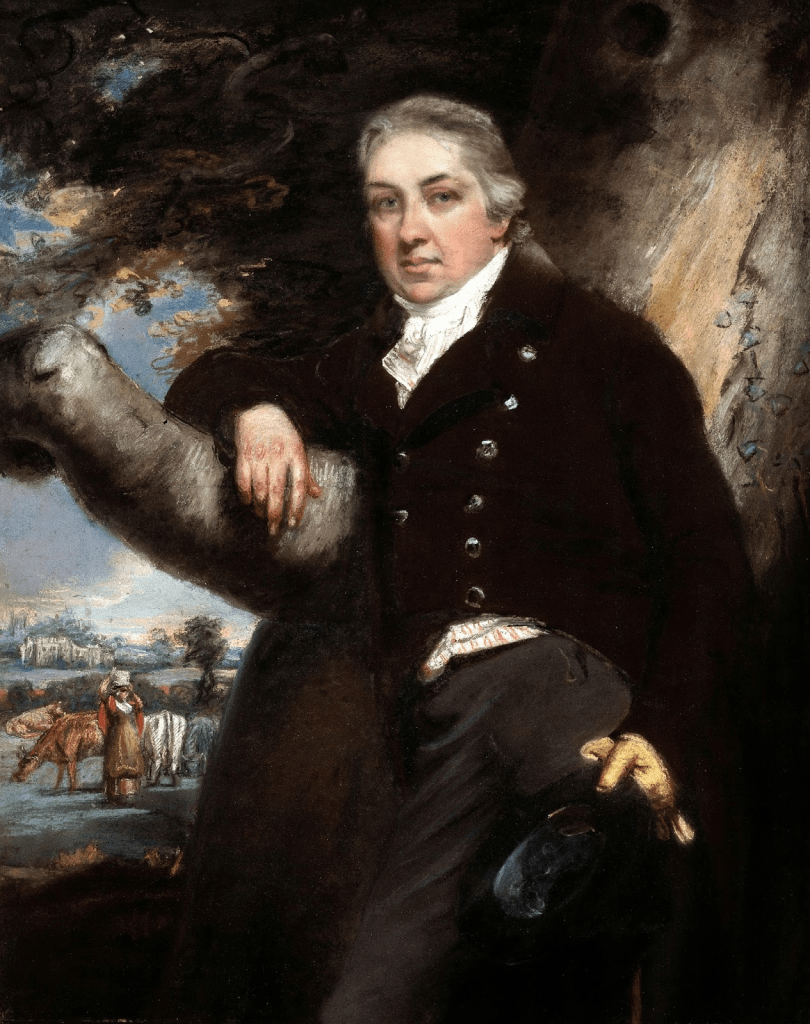
The quest to understand and combat smallpox had spanned centuries. In 1796, English physician Edward Jenner (1749-1823) achieved a historic breakthrough by creating the first vaccine. It was a milestone in the history of medicine but the disease lingered. Its continued impact into the 20th century is a stark reminder of the importance of eradicating such diseases.  1969, the World Health Organization (WHO) finally declared that smallpox was eradicated. 

What is Smallpox?                          

To fully appreciate the magnitude of this achievement, it is crucial to comprehend the nature of smallpox. We must understand its characteristics, its mode of transmission, and its impact on diverse populations worldwide.  Diseases happen when pathogens (the agents that cause disease) such as viruses, bacteria and fungi infect the tissue of a living being. Pathogens include viruses, bacteria, and fungi. They infect the tissue of living beings.  Symptoms occur when the pathogen releases toxins as they multiply, spread or even kill cells.  Diseases occur when pathogens infect the tissue of a living being.

Smallpox is a virus that is a parasite of animals, plants, and bacteria.  Some examples include the common cold, influenza, smallpox, AIDS, herpes, hepatitis, polio, and rabies. As parasites, viruses need a host to reproduce. They achieve this by infecting host cells and hijacking their machinery to survive and multiply. Outside of a host, viruses are inert. Contagious diseases can be passed between organisms (e.g. person to person) in various ways – direct contact (touch), indirect contact (with an infected object), and airborne (coughing, sneezing). When infection sets in, it sickens or even kills us.   

Like measles and whooping cough, smallpox is a so-called “crowd disease.” This term is used to describe diseases that spread rapidly in densely populated areas. They are particularly dangerous and difficult to control. This is due to their high transmission rates and potential for widespread outbreaks.    

Microscopic image of a virus

Smallpox is a Zoonotic disease. It is shared among people and sometimes between other animals like bats, monkeys, and livestock.  Smallpox infects humans but not other animals. Other zoonotic diseases include measles, HIV, AIDs, chicken pox, and SARS. Collectively, they are the deadliest diseases in human history.

Arguably the most lethal of the lot, smallpox is an influenza (flu)that scientists later discovered is caused by an Orthopoxvirus. (Snowden,87) The medical name for smallpox is variola virus. Virologists identify two kinds of smallpox. Variola major has a mortality rate of 25 to 30 percent. Variola minor has mild symptoms and a death rate of 1 percent or less. Variola major is the focus of this study.

What made smallpox so deadly?

Smallpox (variola major) has many dangerous traits, including its mode of infection and its adaptability to various climates. Regarding infection, it is highly contagious and transmitted mainly through droplets exhaled through coughing or sneezing. It can only be spread from human to human, not to other animals. The disease can also spread from the corpses of smallpox victims and contaminated items like linens.

Abetting its spread is that smallpox infects a host slowly with no immediate signs of illness. From the time of infection, the incubation period is nine to fourteen days. The infected experience symptoms such as fever, chills, headaches, and nausea. These symptoms could be confused with other ailments. Since symptoms do not appear for a week or two, people could unknowingly infect others for a week or two.  After incubation, the overt symptoms include lesioning and skin rashes.  Survivors could be blinded or permanently scarred. Some died. It ultimately kills by attacking the internal organs – the liver, lungs and heart.  Infants are the most vulnerable.  Survivors of smallpox did not become infected again, an essential trait that facilitated its eventual eradication. 

Smallpox also demonstrated a remarkable ability to survive in diverse climates. This includes the cooler temperatures of Northern Europe. This adaptability allowed smallpox to extend its reach far beyond the tropical regions where diseases like malaria thrived. Adaptability, contagiousness, and lethality made smallpox a pervasive and influential force in shaping human events. Its resilience, even in the face of diverse climates, underscores the gravity of this deadly disease’s impact on human history.

Smallpox and History

Scholars increasingly acknowledge the role of smallpox and other diseases in the unfolding of history.  In his 2019 book, Epidemics and Society: From the Black Death to the Present, Frank Snowden writes that diseases are “a major part of the ‘big picture’ of historical change.” They are crucial for understanding historical development. They include societal developments such as economic crises, wars, revolutions, and demographic change. (2)  Human history is littered with diseases like the plague, cholera, and the Spanish flu. Smallpox (variola major) is one of history’s most formative diseases and perhaps the deadliest.      

Origins  

Where did smallpox come from? Archaeological findings suggest smallpox and other diseases have a very long history. These diseases grew out of what sociologist Jonathan Kennedy calls “an epidemiological revolution.” This revolution followed hot on the heels of the Neolithic Revolution (c 10,000 to 8,000 BCE). This period saw some humans change from nomadic lifestyles to sedentary farm-based communities with more sustained interaction with domesticated animals.  (Kennedy, 43).  So, while we do not know the exact origins of smallpox, scholars have extrapolated its likely origins. Since it is a Zoonotic disease, closely related to cowpox found in animals like bovines and rodents, it likely grew out of the Neolithic period.

Early Cases. 

Even with today’s sophisticated archeological methods, it is difficult to determine the first cases of smallpox. The scant written records and rudimentary scientific knowledge of ancient peoples’ diseases mean that potential cases of smallpox could also be other diseases, such as measles, the bubonic plague or typhus.  Archeologists might have found evidence of instances of smallpox in ancient Egypt. Three mummies, including the young Pharoah Ramses V, who died in 1157 BC, were found with what looked like pockmarks. Written sources from Asia describe potential cases of smallpox in China (1122 BC) and India (1500 BC). Again, these are not definitive.

Smallpox and the Mediterranean

Whatever its specific origins, smallpox eventually spread throughout the world, enabled by denser populations and improvements in transportation technology that facilitated more human interactions through trade, migration and war.   Egypt, a potential source of smallpox, sits south of the Mediterranean Sea, a hub of interaction. As historian David Abulafia points out, “The sea routes of the Mediterranean have always provided a means for the transmission of pandemics,” like the Justinian plague in the sixth century AD and the Black Death in the fourteenth century AD. (144) 

Some scholars believe smallpox impacted the Peloponnesian War (431-404 BC), which saw Athens fight Sparta for regional supremacy.  In 430 BC, the Plague of Athens devastated that city, killing a quarter of the population over three years and severely weakening the Athenian war effort, thus facilitating Sparta’s victory. (Kennedy, 60). Other scholars have suggested measles or the bubonic plague. It is difficult to discern since contemporaries, as Abulafia points out, “saw these events as divine punishment rather than pathologies.” (144)  Thucydides is often cited for his observations of the Athenian plague but does not describe the disease symptoms in a manner that would verify it was smallpox. 

For some, smallpox is the prime suspect behind the Antonine Plague (164-165 AD) in the Roman Empire during the reign of Marcus Aurelius (161-180 CE). Fatality estimates vary but may have been in the millions. Historian Mark Thompson and others suggest that soldiers brought the disease back home after fighting in Mesopotamia. Contemporary Greek physician Galen described the symptoms as “diarrhea, high fever, and the appearance of pustules on the skin after nine days.” (Kerhaw 211).  By this time, the Roman Empire displayed vulnerabilities and epidemics such as the Antigone Plague, further weakening its resilience by disrupting the Roman economy, labour force, and army. 

More Reliable Accounts

We find more reliable accounts of smallpox and other diseases as written records improve.  However, only in the fourth century AD “can we find the first unmistakable description of smallpox in China. (Hopkins, 104).  There is some debate about how it initially entered China. Some argued that it first came from the Huns, a nomadic tribe to the north.  Hopkins, for instance, points to early accounts of what might be smallpox in China from around 250 BC and introduced by the Huns a few decades before the creation of the Great Wall. Some Chinese called it the “Hunpox” epidemic, reflecting their sense of its source. (Hopkins, 101) Again, the records are scant, so confirming that this “Hunpox” was smallpox is difficult. Other scholars challenge the “Hun origin” theory and suggest smallpox might have been introduced to China centuries later via India, along with the introduction of Buddhism around 65 AD. (Hopkins, 104). 

 Smallpox might have spread to the Korean peninsula around 48 AD. While Japan was separated from the mainland by water, the disease eventually reached the island country around 585 AD and wreaked havoc. Historian Charles Holcombe estimates that an epidemic in 735-737 AD may have killed a quarter of Japan’s population. (Holcombe, 118)

Smallpox became established as an “Old World Disease.” 

Smallpox eventually migrated throughout Europe, a continent significantly less densely populated and travelled than Asia, the Near East, and the Mediterranean until the early modern era. Historian Frank Snowden and other scholars suggest that the virus spread during the Crusades of the eleventh and twelfth centuries, as soldiers and pilgrims travelled back and forth between Europe and the Levant, the general area of what is now Israel, Lebanon, and Syria (97, Snowden). Over time, as European populations increased and interregional interactions became more frequent, smallpox and other diseases became endemic. 

Smallpox became endemic throughout most parts of Eurasia, or the “Old World.” Biologist Frank Fenner writes, “By 1000 AD, smallpox was probably endemic in the more densely populated Eurasian landmass from Japan to Spain and the African countries on the southern rim of the Mediterranean. (402).  By the 14th century, smallpox was established in Germany, Spain and France.  By the latter half of the 16th century, smallpox was endemic to Europe.

Smallpox, the “New World” and the Columbian Exchange

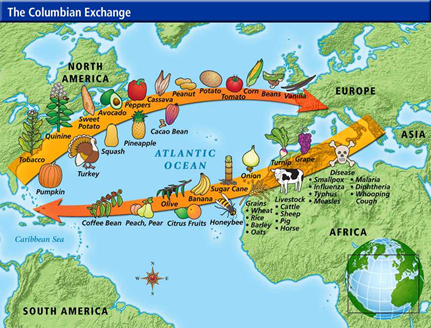
Smallpox finally made its way to the Americas in the sixteenth century.  Advances in navigation and shipbuilding and a growing appetite for trade with the faraway lands of India and China compelled European powers to seek reliable sea routes to these markets.  Christopher Columbus reached the Americas in 1492.  Later voyages and settlements led to what Alfred Crosby called the “Columbian Exchange,” the transatlantic transmission of technologies, foods, and diseases.  
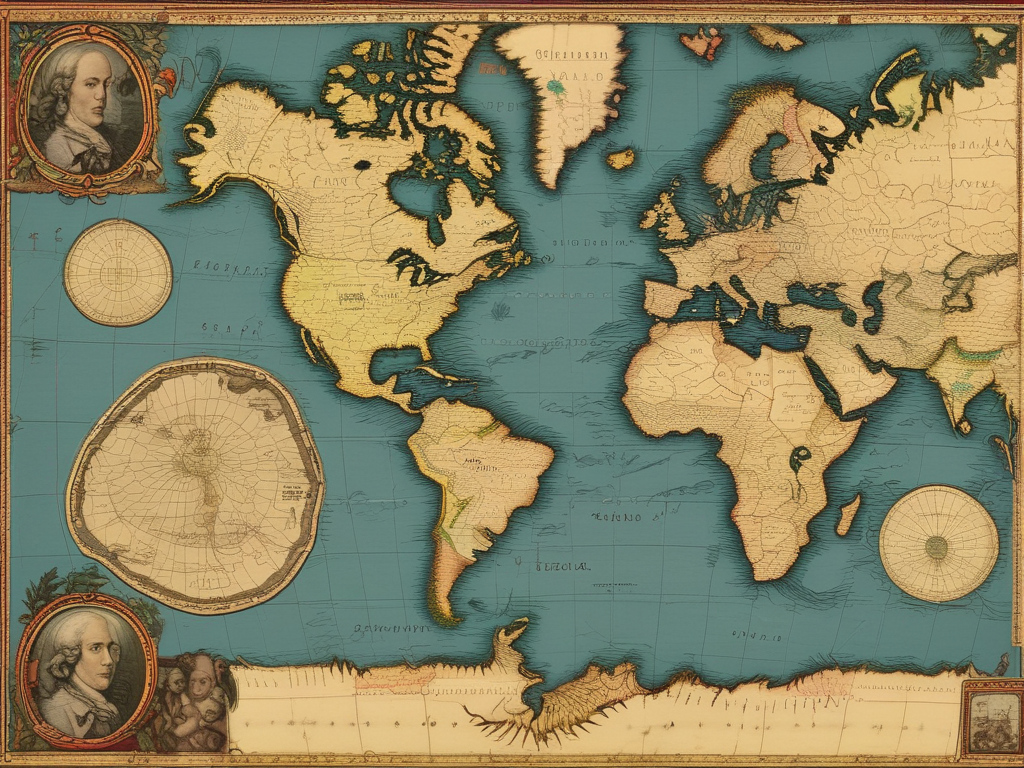
As part of this exchange, smallpox served as the primary biological culprit (other Old World diseases like measles contributed) in an epidemiological onslaught that would lead to the death of more than 90% of the indigenous population of the Americas (60.5 million in 1500 to 6 million a century later).

This demise facilitated the eventual European domination of the “New World. (Kennedy, 127).  Moreover, the decimation of the Indigenous population, coupled with malaria’s devastation of European settlers in the warmer parts of America, encouraged, from the late 17th century onwards, the import of African slaves who had developed more immunity and so provided a more secure labour force.  African slaves, travelling in tightly packed ships that served as incubators, also unwittingly spread smallpox and other diseases to the Americas.

Smallpox After 1600 AD

As the world became more interconnected through war, migration and trade, smallpox became endemic to many parts of the world and continued to impact human affairs. Snowden writes that in Europe during the 17th and 18th centuries, smallpox “replaced bubonic plague as the most feared of all killers.” (97). Most people became infected during their lifetimes. While indigenous people of the Americas suffered the worst devastations, Europeans still felt its deadly touch despite variolation and other mitigating factors, like improved public hygiene and better nutrition.  People were more likely to die from infectious diseases than today’s leading causes of death, cardiovascular disease and cancer. (Berman, 13)  Some estimates suggest smallpox caused a tenth of all European deaths during the 18th century and “a third of all deaths among children younger than ten.” (Snowden 98). It was also the continent’s leading cause of blindness. 

In Asia, smallpox shaped territorial competition and reduced local population numbers.  In 1759, China’s Qing dynasty defeated the Western Mongols.  Military prowess partially explains the outcome, but as historian Charles Holcombe writes, the Mongol’s demise might have been more from smallpox, “a disease to which Mongols were shockingly vulnerable.” (168, Holcombe).

As mentioned earlier, smallpox had wiped out a quarter of Japan’s population in 735-7 AD. Japan experienced many epidemics in the following centuries, particularly in its more densely populated regions. However, as populations spread to frontiers, so did smallpox. During the 19th century, the disease spread to Northern Japan, with Japanese settlers migrating to Hokkaido, drastically reducing the minority Ainu population. 

Smallpox also thrived in India.  Jayant Banthia and Tim Dyson note that “case fatality in India from smallpox was high – in the vicinity of 25-30 percent in unprotected populations, higher than recent estimates for eighteenth-century Europe.” (676)  

Edward Jenner and the First Vaccine (1796)

Edward Jenner created a smallpox vaccine (the first ever vaccine) in 1796, but it would take time to distribute globally.  In the meantime, smallpox continued to thrive.  The Franco-Prussian War triggered a smallpox pandemic of 1870–1875 that claimed 500,000 lives.  Vaccination was mandatory in the Prussian army, but many French soldiers were not vaccinated, so smallpox outbreaks among French prisoners of war spread to the German civilian population and other parts of Europe.

This public health disaster ultimately inspired stricter legislation in Germany and England, though not in France.   Smallpox continued to wreak havoc into the next century and “may have caused the death of as many as 300 million people in the 20th century alone. (Khan and Darwez,21)

Conclusion.

Dr. Michael Osterholm’s description of smallpox as “one of the scariest monsters on earth” is not hyperbole. The disease killed billions and caused immeasurable suffering.  Due to its adaptability and resilience, smallpox thrived on most continents.  Its demographic devastation, most notably in the Americas, profoundly impacted human history. 

It’s one weakness is that it can’t infect a person more than once, facilitating the effectiveness of vaccine treatment and the disease’s demise.  The history of smallpox and other diseases offers valuable lessons and insights.  We would be wise to heed them in a world with a growing population and greater interaction.

Bibliography

Alden, Dauril, and Joseph C. Miller. “Out of Africa: The Slave Trade and the Transmission of Smallpox to Brazil, 1560-1831.” The Journal of Interdisciplinary History 18, no. 2 (1987): 195–224. https://doi.org/10.2307/204281.

Banthia, Jayant, and Tim Dyson. “Smallpox in Nineteenth-Century India.” Population and Development Review 25, no. 4 (1999): 649–80. http://www.jstor.org/stable/172481.

Berman, Jonathan M. Anti-Vaxxers: How to Challenge a Misinformed Movement. Cambridge, Massachusetts, The MIT Press, 2020.

Chang, Chia-Feng. “Disease and Its Impact on Politics, Diplomacy, and the Military: The Case of Smallpox and the Manchus (1613–1795).” Journal of the History of Medicine and Allied Sciences 57, no. 2 (2002): 177–97. http://www.jstor.org/stable/24623679.

Fenner, Frank. “Smallpox: Emergence, Global Spread, and Eradication.” History and Philosophy of the Life Sciences 15, no. 3 (1993): 397–420. http://www.jstor.org/stable/23331731.

Fenner, Frank. “SMALLPOX IN SOUTHEAST ASIA.” Crossroads: An Interdisciplinary Journal of Southeast Asian Studies 3, no. 2/3 (1987): 34–48. http://www.jstor.org/stable/40860242.

Holcombe, Charles.  A History of East Asia: From the Origins of Civilization to the Twenty-First Century.  New York: Cambridge University Press, 2011.

Hopkin, Donald R. The Greatest Killer: Smallpox in History. Chicago: The University of Chicago Press, 2002.

AMALIE M. KASS. “Boston’s Historic Smallpox Epidemic:” Massachusetts Historical Review (MHR) 14 (2012): 1–51. https://doi.org/10.5224/masshistrevi.14.1.0001.

Kennedy, Jonathan. Pathogens: A History of the World in Eight Plagues. Toronto: Random House, 2023.

Kershaw, Stephen P. A Brief History of the Roman Empire: Rise and Fall.

Khan, Gazala, and Sazzad Parwez. “A Historical Narrative on Pandemic Patterns of Behavior and Belief.” Journal of Global Faultlines 9, no. 1 (2022): 21–32. https://www.jstor.org/stable/48676220.

Li, Yu, Darin S. Carroll, Shea N. Gardner, Matthew C. Walsh, Elizabeth A. Vitalis, and Inger K. Damon. “On the Origin of Smallpox: Correlating Variola Phylogenics with Historical Smallpox Records.” Proceedings of the National Academy of Sciences of the United States of America 104, no. 40 (2007): 15787–92. http://www.jstor.org/stable/25449217.

Manley, Jennifer. “Measles and Ancient Plagues: A Note on New Scientific Evidence.” The Classical World 107, no. 3 (2014): 393–97. http://www.jstor.org/stable/24699810.

Martin, Sean. A Short History of Disease: Plagues, Poxes and Civilizations.  Herts, UK: Pocket Essentials, 2015.

Mnookin, Seth.  The Panic Virus: A True Story of Medicine, Science, and Fear.  New York: Simon and Shuster, 2011.

Morens, David M., and Robert J. Littman. “Epidemiology of the Plague of Athens.” Transactions of the American Philological Association (1974-) 122 (1992): 271–304. https://doi.org/10.2307/284374.

Pas, Remco van de. “Epidemics in the Colonial Era.” Globalization Paradox and the Coronavirus Pandemic. Clingendael Institute, 2020. http://www.jstor.org/stable/resrep24671.6.

Osterholm, Michael T. and Mark Olshaker. Deadliest Enemy: Our War Against Killer Germs. New York: Little, Brown and Company, 2020.

Riley, James C. “Smallpox and American Indians Revisited.” Journal of the History of Medicine and Allied Sciences 65, no. 4 (2010): 445–77. http://www.jstor.org/stable/24631803.

Snowden, Frank M.  Epidemics and Society: From the Black Death to the Present, Yale University Press, 2018

Sohal, Sukhdev Singh. “Revisiting Smallpox Epidemic in Punjab (c. 1850 – c. 1901).” Social Scientist 43, no. 1/2 (2015): 61–76. http://www.jstor.org/stable/24372964.

Thein, MM, LG GOH, and KH Phua. “The Smallpox Story: From Variolation to Victory.” Asia Pacific Journal of Public Health 2, no. 3 (1988): 203–10. http://www.jstor.org/stable/26720502.

Thomson, Mark. “Junior Division Winner: The Migration of Smallpox and Its Indelible Footprint on Latin American History.” The History Teacher 32, no. 1 (1998): 117–31. https://doi.org/10.2307/494425.

Vögele, Jörg, Luisa Rittershaus, and Katharina Schuler. “Epidemics and Pandemics – the Historical Perspective. Introduction.” Historical Social Research / Historische Sozialforschung. Supplement, no. 33 (2021): 7–33. https://www.jstor.org/stable/27087273.

Warren, Christopher. “Could First Fleet Smallpox Infect Aborigines? – A Note.” Aboriginal History 31 (2007): 152–64. http://www.jstor.org/stable/24046734.
What is Authoritarianism?  


Concepts have histories. They appear at specific times, change meanings at times, and disappear sometimes. Adam Przewarski

 For a political system that affects the lives of so many, authoritarianism remains a surprisingly fuzzy concept. Ruth Ben-Ghiat

In the introduction to our series on authoritarian tactics, we noted how a significant increase in global authoritarianism since 1990 has spurned the publication of numerous books, articles, and podcasts that focus on authoritarianism past and present.  Many of these contributions warn of authoritarian’s danger to liberal democracies and remind us of the dangers of past autocratic leaders like Mussolini, Stalin and Hitler.

But what is authoritarianism?  How does it differ from democracy, totalitarianism, and other forms of government?  Are there different versions of authoritarianism? If so, what discernible traits do they share?  This series of blogs focuses on “authoritarian tactics,” but it is worthwhile to begin by exploring how people have defined authoritarianism.  This blog will explore how scholars have contrasted authoritarianism with democracy and totalitarianism.  We also investigate how modern scholars have traced how post-19th-century authoritarianism evolved from the early communist and fascist regimes to various military coups and finally to the 1990s and beyond with what scholars call the “new authoritarianism.” 

Authoritarianism: A Relatively New Term

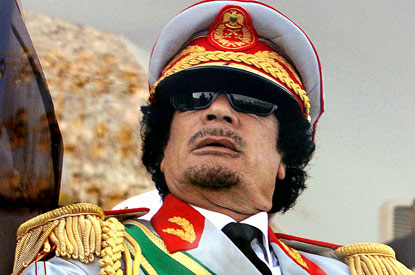
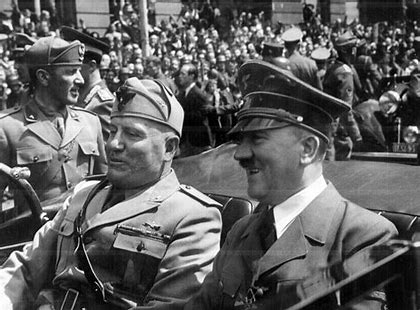
As political scientist Adam Przewarski writes, “Concepts have histories.” (17). Political terms such as democracy, monarchy, dynasty, and communism have existed for centuries.  “Authoritarianism” is relatively new, initially conceived as a regime distinct from “totalitarianism,” another term created in the 20th century to describe the regimes of Stalin’s Soviet Union, Hitler’s Germany and, for some, Mussolini’s Italy. (Przewarski,18) These totalitarian states eventually faltered. However, commentators continued to use authoritarianism to describe various regimes in the latter half of the 20th century and the beginning of the 21st, ranging from Franco’s Spain to Muammar Gaddafi’s Libya and Augusto Pinochet Ugart’s Chile, who achieved power through military coups to democratically elected Viktor Orban in Turkey, Recep Tayyip Erdogan in Turkey Russia’s Vladimir Putin.

Do these regimes have enough similarities to be collectively defined as “authoritarianism”? One consistent claim among scholars is that authoritarianism is anti-democratic.  We will begin here.

Authoritarianism as “Anti-Democratic”

Commentators frequently contrast authoritarianism with democracy, another problematic term.  The notion of a government by the people misleads in the sense that not all people actively participate in politics. Few do. Representative democracy, whereby people elect officials to rule on their behalf, is closer to reality in countries claiming to be democratic but remains lofty as many peoples’ interests are readily neglected. In various cases, government “by the people” has been delimited by discriminations of race, gender and class.  Athenian democracy, for instance, involved public debate and consent but excluded, among others, women and slaves.  Most Western democracies, such as Canada and the United States, did not extend voting rights to women until after World War One. These days, the financial backing of electoral candidates and gerrymandering undermine equal public involvement and influence.   Philosopher Peter Cave notes that contemporary democracies “are usually oriented to professional politicians competing for votes to become the people’s representative.” (59). He adds that financial support and charisma play big roles in the “public’s careful scrutiny of policy platforms.” ( 59)

Still, scholars use democracy or principles of democracy as counterpoints to authoritarianism. Noting how definitions of democracy have changed since antiquity, Przeworski writes that “these days” democracy means “a system where power is exerted in the name of and on behalf of the people by the process of elections that also allow them to vote out an incumbent (e.g. an elected President or Prime Minister).   In other words, democracy is essentially “rule by consent” as legitimized by free and fair elections.  

This notion of “public consent” is central to definitions of authoritarianism.   For instance, the Dictionary of Political Thought describes authoritarianism as “The advocacy of government based on an established system of authority rather than on explicit or tacit consent.” (Scruton 32).  The Chamber’s Dictionary of World History offers a more substantial definition, defining authoritarianism as

A form of government advocating such government is the opposite of democracy in that the consent of society to rulers and their decisions is not necessary. Voting and discussion are not usually employed except to give the government the appearance of democratic legitimacy, and such arrangements remain firmly under the control of the rulers.  Authoritarian rulers draw their authority from what are claimed to be special qualities of a religious, nationalistic, or ideological nature, which are used to justify their dispensing with constitutional restrictions. Their rule, however, relies heavily upon coercion. (64)   

This Chamber’s definition also focuses on consent, noting that authoritarian regimes do not embrace “democratic practices” such as voting and open discussion but sometimes allow them to “give the appearance of legitimacy.”  Authoritarian authority also stems from sources other than public consent, such as religion (the Papal theocracies of the Holy Roman Empire, post-1979 Iran), nationalism (Russia’s Putin), and ideology (Lenin or Mao and their brands of communism). These sources of authority transcend constitutional restrictions in the name of the greater good of the people (e.g., the nation) and allow governments to forgo public consent and consolidate political power.

Political scientists, historians and journalists elaborate on these general descriptions of authoritarianism as “anti-democratic.” Besides public consent, they refer to democratic qualities such as pluralism, freedom of expression and limits on executive power. Political scientist Dr. Martha Crone defines authoritarian regimes by the “absence” of democratic characteristics, namely universal suffrage, free and fair elections, free competition of political parties, independent judiciary, freedom of press, speech, assembly, and religion.  Journalist and historian Annie Applebaum refers to authoritarianism’s anti-pluralist mindset. She writes, “It is suspicious of people with different ideas. It is allergic to fierce debates. Whether those who have it derive their politics from Marxism or nationalism is irrelevant; it is a frame of mind, not a set of ideas.”  (16)  This frame of mind, as Applebaum puts it, encourages public conformity to government directives while discouraging dissent.

One of the more notable efforts to define authoritarianism hails from Yale political scientist Juan Jose Linz (1926 -2013).    Like Crone and Applebaum, he highlighted a limited political pluralism that constrains political alternatives (e.g. competing political parties) to the incumbent power.  Linz also highlighted authoritarian legitimacy based on fear rather than a reason-based platform.  Examples here include Chile’s Pinochet’s  (1973-1990) fight against leftist forces and Vladimir Putin’s emphasis on the threat of “the West.”  These fears often focus on a malicious threat but can also refer to economic problems or loss of social status of particular groups.  Linz adds that authoritarian leaders have vague and shifting executive powers.  A modern-day example would be Russia’s Putin, who won the election in 1990 but drastically increased his powers while exceeding the traditional two-term limit as we approach 2024.    

It should be noted that Linz’s definition of authoritarianism focused on its anti-democratic nature and how it differed from totalitarianism.  With that in mind, let us turn our attention to totalitarianism.   

Authoritarianism as Distinct from Totalitarianism

All within the state, none outside the state, none against the state. Benito Mussolini.

So far, the definitions of authoritarianism focus on traits deemed anti-democratic.  However, totalitarian regimes also have these antidemocratic qualities.  So, why identify a regime as authoritarian rather than totalitarian?   Is there an essential difference?  As Adam Przewarski writes, “We need to ask if there is something specific to authoritarianism that distinguishes it as a type of dictatorship, other than a watered-down totalitarianism that would make either term “redundant.” (19).

Before focusing on distinguishing features, we should explore what scholars mean by totalitarianism.  One place to begin is Hannah Arendt (1906-1975), who focusedon Nazi Germany (1933-1945) and Stalin’s Soviet Union, particularly from the great purges of 1927 and 28 to the Soviet leader’s death in 1953. Arendt identified various characteristics that defined these polities as totalitarian.  One was totalitarianism’s anti-pluralism, which relegates everyone as part of a political mass under the control of a centralized power.  Here, class and other differences are erased to favour one identity, and citizens are subservient to the state. Moreover, there is no separation of public and private. The state controls all facets of life.  As Marvin Perry writes, “The party-state determines what people should believe, what values they should hold.  There is no room for individual thinking, private moral judgement or individual concerns – no natural rights, civil liberties that the state must respect.” (767)

Totalitarianism also aligns with an ideology or “absolute” law.  For Lenin and subsequent Russian leaders, Marx’s law of history dictated the eventual collapse of capitalism and the creation of classless societies.  In Nazi Germany, the ideology was grounded in “nature”; the eugenics-informed racial theories that saw a superior Aryan race winning the historical racial struggle against “inferior races” such as Jews, blacks, and Slavic peoples.  For both regimes, these “inevitable” historical forces justified the state’s drastic and brutal efforts to consolidate its power and quash dissent. Accordingly, Nazi Germany claimed the imprisonment and extermination of certain people accorded with the natural order of things. Stalin justified his purges in line with a historical determinism that led to a classless society. In short, ideology informs a grand narrative that justifies state actions. 

In totalitarian regimes, these “inevitable” laws are guided by an “infallible” leader like Hitler or Stalin, whose cult of personality puts them beyond public criticism or restraints.  They can act with virtual impunity as the state does their will, which includes mass terror to encourage conformity and punish “enemies of the state.” Hitler ordered mass murders and genocide, and Stalin’s purges of 1937 and 1938 saw millions of Soviet people arrested, sent to labour camps or executed.   Show trials and public executions sent a strong message to potential dissidents.

Contemporary definitions of totalitarianism generally align with Arendt.  For instance, philosopher Alan Ryan describes totalitarianism as

“a set of political phenomena that includes dictatorship; one-part rule; systematic violence against enemies, including but not limited to political dissidents; the use of state terror as an everyday instrument of government; the destruction or politicization of all institutions save those created by the ruling party; and the systematic blurring of the line between the public and the private; all this in the interests of securing the total control of a political elite over every aspect of life.” (912).  

But how is this different from authoritarianism? 

Authoritarianism and Totalitarianism: Is There a Difference?

Scholars have addressed this question by identifying distinctive totalitarian traits. According to Ryan and others, one difference is the totalitarian intrusion of every aspect of life, including private life. Alan Ryan writes that Fascism, for instance, was overtly totalitarian in demanding total loyalty to one’s country and deeply hostile to the liberal separation of private and public attachment.” (914). Political scientist Jerzy J. Wiater echoes Ryan, saying, “Totalitarian dictatorships – unlike the authoritarian one – try to extend their power to all aspects of life, making them part of politics.” (78)  Totalitarian regimes achieved this in my ways, including mass surveillance and controlling education and speech.    Stalin’s Soviet Union, for instance, controlled where people lived, what they consumed, who went to university and what they studied. 

Scholars also point to totalitarian leaders’ virtually unbridled power that far exceeds that of authoritarian heads of state. Arendt noted that the totalitarian leader is not bound by any rule of law.  In Nazi Germany, for instance, it was the will of the Fuher that ruled supreme. Jose Linz echoes this point, writing that totalitarian leaders are “unconstrained by laws and procedures,” whereas “authoritarian leaders work with a political system within formally ill-defined but quite predictable norms.” (Wiater 78) In short, leaders like Hitler and Stalin could act with impunity as there were no checks and balances on their power.  So, while authoritarian regimes included limited pluralism (e.g., other political parties and oppositional media), totalitarian regimes did not allow any level of pluralism.  Simply put, Stalin’s Russia and Hitler’s Germany did not tolerate any political competition or dissent.    

Linz and others also noted that authoritarianism does not involve the elaborate ideologies of totalitarian regimes, nor do they usually “cultivate the cult of the leaders with quasi-religious overtones, making them secular versions of the prophets.” (Wiater 78) For instance, Stalin’s successors, like Khrushchev and Brezhnev, were powerful but did not possess the same cult of personality as Stalin. (Wiater, 78)    

Lastly, scholars note that totalitarianism is a particular and rare political entity.  For Arendt, only Nazi Germany and Stalin’s Soviet Union fit the criteria.  Other scholars include Mao’s China, Mussolini’s Italy and Kim Il Sung’s Korea.  So, there remains some debate about what distinguishes totalitarianism from authoritarianism. However, there seems to be a consensus that totalitarianism is unique in the leader’s unbridled power (unrestrained by the rule of law), the cult of personality, its control of public life, and its deterministic ideology (e.g. Nazism or Stalinist communism).  

Old and New Authoritarianism.

While scholars note totalitarianism as a rarity, authoritarianism includes a broader base of regimes based on how they gain and consolidate power.  Some identify two general categories: old authoritarianism and new authoritarianism.  What is the difference between old and new? One focal point of contrast is how regimes gain and then maintain power.  University of Michigan political scientist Erica Franz outlines the two authoritarian types in Authoritarianism: What Everybody Needs to Know (2018).

A regime is authoritarian if the executive achieves power through undemocratic means, this is any means besides direct, relatively free and fair elections (e.g. Cuba under Castro and his brother) or if the executive achieved power via a free and fair election but later changed the rules such that subsequent electoral competition (whether legislative or executive) was limited. (e.g. Turkey under Recep Erdogan). (92)

In short, old authoritarian regimes achieve power without democratic consent, usually via a military coup, and the new ones gain power through fair elections but compromise future elections to prolong power and erode checks and balances on executive power.  Let us take a closer look at both options.

Old Authoritarianism

For old authoritarianism, “undemocratic mean” usually involves coups and revolutions from the likes of Lenin in Russia, Franco in Spain, Mao Zedong in China and Pinochet in Chile. None of these regimes were able to control private lives like the totalitarian regimes of Stalin or Hitler, and ideology did not necessarily guide their rule.  However, these old authoritarian regimes used explicit coercion and violence to gain and consolidate power.  According to political scientists Steven Levitsky and Lucan Way, these coups happen in two fundamental ways.  One way is when someone within the political and military establishment takes over the existing government institutions – a “top-down” movement. Franco and Pinochet, for instance, were military leaders who deposed and replaced the incumbent leadership with military force.  In both cases, prominent military leaders took over the existing political and military institutions.  The other is a social revolutionary coup. Parties lead this “bottom-up” movement from outside the political or military establishment.  Mao Zedong and Fidel Castro gained power through guerilla warfare as leaders outside the political establishment. 

New Authoritarianism

The “new” form of authoritarian regimes tends to refrain from violence as a tool of power. Instead, it achieves power through free and fair elections, consolidating power by weakening checks on its power.  Scholars describe this process as “democratic backsliding,” which Erica Franz describes as the “changes in the formal political institutions and informal political practice that significantly reduce the capacity of citizens to make enforceable claims upon the government. It is essentially the erosion of democracy.” (Franz, 92) In short, these governments undermine, control, or abolish those institutions, groups or individuals who threaten to abbreviate their political tenure or power.  Unlike totalitarian and some old authoritarian regimes, there are competing political parties, but new authoritarians strive to ensure they are not real threats to their power.  A telling example is Vladimir Putin of Russia, who won his 1990 election but changed “the rules of the game” to ensure that elections would result in his win.  Other contemporary leaders like Victor Orban in Hungary and Turkey’s Precep Erdogan have implemented changes to favour their victories – albeit more subtly than Putin. 

Political scientists Steven Lewitsky and Lucan Way describe this as “competitive authoritarianism,” they define as “civilian regimes in which formal democratic institutions exist and are widely viewed as the primary means of gaining power but in which the incumbent’s abuse of the places them at a significant advantage vis a vis their opponent…competition is real but unfair.” (26, Przeworski)  This definition would exclude Franco’s Spain and contemporary China, which do not utilize democratic institutions to justify their rule, but would include contemporary leaders such as Putin, Orban and Erdogan, who have won a series of elections.    

Besides electoral manipulation, these new authoritarians take other measures by eroding institutional checks on executive power, such as the judiciary, the media and the Constitution.  Victor Orban’s Fidesz party won a majority election in Hungary in 2010.  A year later, his party made a constitutional amendment that allowed a majority government to appoint judges.  As journalist Gideon Rachman points out, the “court was gradually packed with judges sympathetic to Orban and stripped of some of its review powers.” (95) Poland’s Law and Justice Party (2015-2023) violated the constitution by taking control of the public broadcaster and firing experienced presenters and journalists in favour of party sympathizers. (Applebaum, 5). They also purged the civil service.  In all cases, these steps served to undermine checks on party power.  

Conclusion

As historian Ruth Ben-Ghiat points out, “authoritarianism remains a surprisingly fuzzy concept.”  Scholars have defined it in contrast to liberal democracies and totalitarianism and have identified old and new authoritarian versions, the latter being a less overtly oppressive system that retains elements of liberal democracies such as elections – fair or otherwise. 

Another approach to understanding authoritarianism is to step away from a focus on definition and examine authoritarian methods.  Paul Brooker describes this approach as “less interested in the tradition ‘who rules’ than in the wider question of ‘how do they rule?’ and particularly their methods of control.” (14)  This approach has been taken up by scholars such as Ruth Ben-Ghiat who prefer to focus on authoritarian practices, or what some refer to as the “authoritarian playbook.”  Such an approach allows us to identify, for instance, how regimes as diverse as Mussolini’s Italy and Orban’s Hungary identified enemies of the state to foster division, erode checks on executive power and prolong stays in power.  In this spirit, we devote the subsequent blogs in this series to these authoritarian practices.   

Our next blog in this series – The Authoritarian Playbook: An Overview

Sources

Applebaum, Annie.  Twilight of Democracy: The Seductive Lure of Authoritarianism. Toronto: McLelland and Stewart, 2020.

Arendt, Hannah. The Origins of Totalitarianism. Cleveland: Meridin Books, 1958

Ben-Ghiat, Ruth. Strongmen: From Mussolini to the Present. New York: W.W. Norton and Company, 2020.  

Bongiovanni, Bruno, and John Rugman. “Totalitarianism: The Word and the Thing.” Journal of Modern European History / Zeitschrift Für Moderne Europäische Geschichte / Revue d’histoire Européenne Contemporaine 3, no. 1 (2005): 5–17. https://www.jstor.org/stable/26265805.

Brooker, Paul. Non-Democratic Regimes: Theory, Government and Politics. New York: St. Martin’s Press, 2000.

Cave, Peter. The Big Think Book: Discover Philosophy Through 99 Perplexing Puzzles. London: One World Publications, 2015. 

Davis, Kenneth. Strongman: The Rise and Fall of Democracy. New York: Henry Holt and Company, 2020

Dikotter Frank.  How to be a Dictator: The Cult of Personality in the Twentieth Century. New York: Bloomsbury Publishing, 2019.   

Franz, Erica, Authoritarianism: What Everyone Needs to Know.  New York: Oxford University Press, 2018.

Friedrich, Carl and Zbigniew K. Brzezinski. Totalitarianism Dictatorship and Autocracy. New York: Frederick A. Praeger, 1965.  

Glasius, Marlies. What authoritarianism is and is not: A practice perspective. International Affairs. 94. 515-533. 10.1093/ia/iiy060. 2018

Law, Diane. The Secret History of the Great Dictators. London: Magpie Books, 2006.

Kohn, Jerome. “Arendt’s Concept and Description of Totalitarianism.” Social Research 69, no. 2 (2002): 621–56. http://www.jstor.org/stable/40971564.

Levitsky, Steve and Lucan Way. Revolution and Dictatorship: The Violent Origins of Durable Authoritarianism. New Jersey: Princeton University Press, 2022.

Linz, Juan. Totalitarian and Authoritarian Regimes. Boulder, CO and London: Lynne Rienner. 2000

Nisbet, Robert. Review of Arendt on Totalitarianism, by Hannah Arendt. The National Interest, no. 27 (1992): 85–91. http://www.jstor.org/stable/42896812.

Przeworski, Adam. “A Conceptual History of Political Regimes: Democracy, Dictatorship, and Authoritarianism.” New Authoritarianism: Challenges to Democracy in the 21st Century, edited by Jerzy J. Wiatr, 1st ed., Verlag Barbara Budrich, 2019, pp. 17–36. JSTOR, https://doi.org/10.2307/j.ctvdf08xx.5. Accessed 23 Oct. 2023.

Scruton, Robert. Dictionary of Political Thought. London: The MacMillan Press, 1982.

Stanley, Jason.  How Fascism Works: The Politics of Us and Them. New York: Random House, 2018.

Wiatr, Jerzy J. “Autocratic Leaders in Modern Times.” Political Leadership Between Democracy and Authoritarianism: Comparative and Historical Perspectives, 1st ed., Verlag Barbara Budrich, 2022, pp. 74–116. JSTOR, https://doi.org/10.2307/j.ctv27tctmb.8. Accessed 23 Oct. 2023.

Authoritarian Practices: Introduction

We do not argue with those who disagree with us, we destroy them. Benito Mussolini

A growing number of astute political observers cite a global trend of authoritarianism since 1990. Countries like Russia, Turkey, India, Hungary and even the United States erode or effectively abolish democratic institutions and freedoms.  These observers – mainly scholars and journalists – situate authoritarianism in a historical context, often beginning with the Fascist leaders of the early 20th century – Italy’s Benito Mussolini and Nazi Germany’s Adolf Hitler and the Communist regimes of Stalin’s Russia and Mao Zedong in China. 

But what is authoritarianism?  How does it take hold of a polity?  How do authoritarian leaders gain and keep power?  Some people refer to these practices as an “Authoritarian playbook.” Of course, authoritarianism is not uniform. It varies in degrees of centralized power and brutality from Hitler and Stalin to Trump’s sustained efforts to erode democracy in the United States.  However, authoritarian leaders often borrow techniques from each other.  For instance, Hitler’s propaganda minister, Joseph Goebbels, travelled to Italy to study Mussolini’s methods to apply them to a rising Nazi Germany.  Donald Trump and his supporters echoed Victor Orban of Hungary’s conspiracy of billionaire George Soros as the leftist boogeyman and adapted Make Hungary Great Again to his MAGA mantra. As scholars like Ruth Ben-Ghiat and Jason Stanley point out, contemporary authoritarian tactics are not new but inspired by past authoritarian leaders.

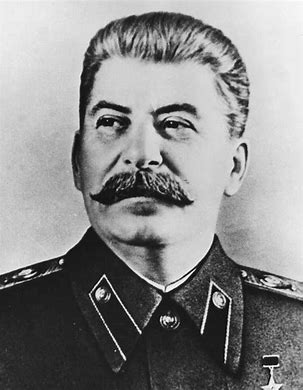
Soviet Leader Josef Stalin

Over the next year, we will publish blogs on authoritarian practices that some call the Authoritarian Playbook.  All writings will focus on the broader context, beginning with the post-WWI years, to explore similarities and crucial differences. 

Here is the list of upcoming topics.  

  1. What is Authoritarianism?  Historical interpretations.
  2. The Authoritarian Playbook: An Overview of Authoritarian Tactics
  3. The National Myth (Mythical Past)
  4. Us vs. Them: Fostering Division and Repression
  5. Attacking the Truth: Eroding Facts and Media credibility
  6. Re-education. Undermining Intellectual Challenges
  7. Undermining Checks and Balances (e.g. Judiciaries)
  8. Cult of Personality – “The Strongman”
  9. Corrupters and Enablers
  10. Using Violence
  11. Resistance and Downfall

Stay tuned for our first blog on authoritarianism – What is Authoritarianism?  Historical interpretations.

Bibliography

Ben-Ghiat, Ruth. Strongmen, From Mussolini to the Present.  New York: W.W. Norton and Company Inc., 2020.

Davis, Kenneth. Strongman: The Rise and Fall of Democracy. New York: Henry Holt and Company, 2020

Glasius, Marlies. (2018). What authoritarianism is and is not: A practice perspective. International Affairs. 94. 515-533. 10.1093/ia/iiy060.

Stanley, Jason.  How Fascism Works: The Politics of Us and Them. New York: Random House, 2018.

Britain and the Origins of the Industrial Revolution, Part 2: Population Growth and Improved Food Production

In Part 1 of our 7-part series on Britain and the origins of the Industrial Revolution, we introduced it as a time of gradual but fundamental change (transformation) in Britain from a dependency on organic resources and means of production to mechanized production using sources such as coal.  Along the way, Britain became more urbanized and expanded its markets domestically and internationally, becoming the world’s foremost power by the early to middle of the 19th century.  How did this happen?  What preconditions facilitated this transformation?   

Part 2 examines one of these preconditions: Improved Farming and Population Growth.

Improved farming and population growth provided essential preconditions for industrialization. Factory owners would need more people to grow their labour force and to buy their products.  More people required more food, and this growing demand hastened agricultural innovations that, in turn, facilitated population growth.  During the 17th century, farms gradually depended less on environmental whims and offered more predictable and productive yields.  Before these changes, people lived according to a traditional cycle of population and productivity.  When food production reached a limit based on available land and agricultural methods, the population reached a threshold, declined, and grew again until it reached production limits. This pattern stemmed from a system where agriculture involved subsistence for peasants and income for landlords and common lands were used for grazing livestock and fuel (e.g. wood).

Commercial Farming, Cash Crops and Enclosures

Various agricultural innovations drastically improved farm production and broke this cycle.  One fundamental change was the development of market-oriented agriculture. Landowners, mainly nobles, increasingly fenced off common lands to create land enclosures focused on growing cash crops for sale and export rather than local consumption. Governments, who sought noble support and tax revenues, supported these measures against peasant resistance – sometimes with armed forces.  This displaced peasants and many became wage earners on far or factories. 

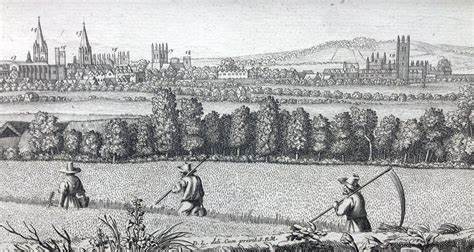
Farmland enclosures

These cash crops created a greater demand for larger fields. Historian John Merriman writes, “Between 1750 and 1850 in Britain, 6 million acres – or one-fourth of the country’s cultivatable land – were incorporated into larger farms. (518)  The trend toward commercial agriculture was well on its way.

Farming Innovations: Crop Rotation and Animal Husbandry

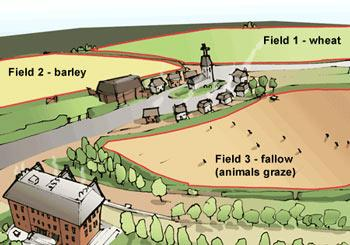
As farming became more commercialized, farmers became more specialized and adopted practices such as crop rotation.  Crop rotation differed from conventional agriculture, which saw farmers plant the same crop in the same place every year while leaving some fields fallow for two or three years to replenish their nutrients. Problems arose as these crops drew the same nutrients out of the soil, thus depleting it. Moreover, pests and diseases could establish themselves more readily.  Crop rotation addressed these problems.  Planting different crops sequentially on the same land optimizes soil nutrients and helps prevent pests and weed infestations. For instance, a farmer might plant corn one season and beans the next. 

Crop rotation

Healthy soil and healthy crops drastically improved food production.  Innovators like Robert Bakewell (1725-1795) improved animal husbandry, enhancing food supplies – particularly protein. 

Technological Advances

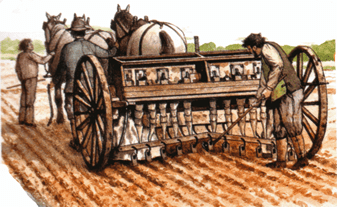
Technological advances also increased productivity. Farmer Jethro Tull (1674-1741) created the seed drill that planted seeds in deep soil, a drastic improvement over simply casting seeds on or near the surface where they would be more vulnerable to the elements or animals. Iron plows allowed farmers to turn the soil more deeply.

The seed drill.

Charles “Turnip” Townsend (1674-1738) learned how to cultivate sandy soil with fertilizer from the Dutch and expanded arable lands (Kagan 495).

More production and more food options.

Throughout the next century, these farming innovations meant fewer people could produce more food, and more food could be grown per acre.  Improved food production also created more varied and calorie-rich diets –fundamental contributors to population growth.  The potato and maize – two nutritious foods from the Americas played essential roles.  Imported from the Americas, the potato became especially widespread throughout Europe.  Donald Kagan writes, “On a single acre, a peasant family could grow enough potatoes for an entire year. (Kagan, 497).  These local developments were bolstered by what Alfred Crosby called the “Columbian Exchange” – the exchange of food, animals, and disease between Europe and the Americas—from this, Europe gained maize, potatoes, sweet potatoes, and cod.  Indentured servants and slaves – laboured to produce these essential foodstuffs. 

Overall, production rates soared. Merriman points out, “England produced almost three times more grain in the 1830s than the previous century.” (Merriman 518) Besides feeding more people, farms produced more fodder for livestock and helped create a more reliable milk and meat source. More livestock also meant more fertilizer (manure).  Fish like the cod harvested off Canada’s east coast offered another protein source. 

Nutrition, Sanitation and Disease

Better nutrition went hand in hand with improved disease prevention and treatment. Diseases like tuberculosis, influenza and dysentery still took many lives but conditions generally improved as cities gradually improved water supplies and waste management.  Medical practices only played a minor role until well into the 19th century. However, Edward Jenner’s vaccines for smallpox in the 1790s helped contain lethal outbreaks, and vaccinations would help stave off other diseases in the next century.  

Edward Jenner (1749-1823)

Rapid Population Growth

Over the eighteenth century the turn of the century, the population of England and Wales increased from about 5.5. million to approximately 10 million and 20.9 million by 1850.  (Cipolla, 29)   Growing numbers in urban centers like Manchester provided cheaper labour for factories to flourish.  Moreover, the combined factors of population growth and increased income per head led to more purchasing power and growing demand for products – – two essential factors for industrial growth.   

 Stay tuned for our next blog in our 7-part series on the origins of the Industrial Revolution in Britain.

Part 3: Access to Foreign Markets and Capital Investment

Britain and the Origins of the Industrial Revolution – Part 1.

The Industrial Revolution marks the most fundamental transformation of human life in the history of the human life in the history of the world recorded in human documents. Eric Hobsbawm

The mid-18th century to the first decade of the 20th century brought fundamental changes in people’s lives and thoughts.  During this time, Western Europe changed from a mainly agricultural region to an industrial one. These changes began in Britain and then spread to Western Europe and the U.S.  Russia, East Europe, and the Balkans came later.  The Industrial Revolution, as this period is called, is considered by many historians to be the most significant development in human history.  It involved, among other things, the creation of new technologies and economic systems as populations shifted from farms and villages to cities. Political systems, economic exchange, social relations, and warfare underwent drastic transformations.  New words like factory, railroad, middle class, capitalism, science, and engineers shaped how people saw themselves and their world (Winks 65).  How did this revolution begin, and how did it fundamentally change human life?  Why did it begin in Western Europe and, more particularly, Britain? 

In this 7-part series of blogs, we will examine the following:

Part 1: Introduction: Defining the Industrial Revolution

Part 2: Population Growth and Improved Food Production

Part 3: Access to Foreign Markets and Capital Investment

Part 4: A (Pre-mechanized Factory) Domestic Manufacturing Economy

Part 5: Technology, the Mechanization of Production and Alternative Sources of Energy (e.g. coal)

Part 6: Land and Water Transport

Part 7: The Textile Industry. 

Defining the “Industrial Revolution”

Scholars continue to debate various aspects of the Industrial Revolution. Even the chronology poses fundamental challenges.  Historian Lindeman writes that the Industrial Revolution offers “no easily identifiable beginning and no discernible end. (Lindeman, 44). Some scholars identify the beginning as the mid-eighteenth century.  Others, like R.C. Allen, go back to the 16th century. 

Considering the topic’s complexity, we need to define our terms.  “Industry” refers to the large-scale processing of raw materials and manufacturing goods in factories. “Revolution” is more problematic as it offers multiple meanings.  In one sense, revolution can be sudden, radical or change.  Historical examples include the French and American Revolutions that fomented sudden political and social change. However, “revolution” also refers to fundamental change. This might be political and socioeconomic change or ways of thinking, such as the Copernican revolution that revealed the Sun (rather than Earth) as the center of the universe or Darwin’s work on evolution.  Such events virtually pervade all aspects of human life, altering how we think and interact with the world.  This certainly applies to the Industrial Revolution.    

Although timelines are still debated, historians agree that the revolution was not sudden but occurred over a long period (150 years or longer), so they focus more on “revolution” as a fundamental change over time.  Donald Kagan writes that the Industrial Revolution “was revolutionary less in its speed, which was on the whole rate slow, than its implications for future of European society.” (Kagan 497) R.C. Allen writes that the Industrial Revolution “is no longer the abrupt discontinuity that its name suggests, for it was the result of an economic expansion that started in the sixteenth century.” (2). Accordingly, some scholars refer to an Industrial Evolution.

Of course, this extended period saw a profound change. The Industrial Revolution, Eric Hobsbawm points out, “was not merely an acceleration of economic growth, but an acceleration of growth because of, and through, economic and social transformation.” (13). The operative word here is transformation.   

What changed?

So, what was this “transformation” or “fundamental change?  One answer is that the Industrial Revolution altered a world ultimately dependent on the earth’s resources and organic means of production – dependencies that limited growth. Food production, for instance, involved people and animals toiling in fields, their productivity limited by land availability and technological limits.  Watermills used water flow but required proximity to a river.  Wind-propelled ships and windmills depended on the wind.  People burned wood to cook, heat homes, and metallurgy this but required access to trees – a rapidly dwindling European resource.  At the beginning of the 1700s, more than 90 percent of the European population lived in rural settings and engaged directly in animal husbandry and agricultural activities.” (MIII, 301) Few urban dwellers worked in factories. 

All of this would change – albeit gradually and in the beginning, only in particular parts of the world. Over time the focus on organic labour and agriculture shifted to alternative sources of energy -especially coal – and the factory-based and mechanized production of goods. (MIII,296) To better understand how this transformation happened, we must explore the preconditions that facilitated these changes. It all began in Britain.

So, this series of blogs will focus on the factors that led to Britain’s gradual transformation into the world’s first industrial nation.

Our next blog: Part 2 Population Growth and Improved Food Production

Bibliography

Allen, Robert. 1994. “Agriculture During the Industrial Revolution, 1700-1850.” In Roderick Floud and Donald N. McCloskey, eds., The Economic History of Britain Since 1700. 2d ed. Cambridge: Cambridge University Press, Vol. I. Ashton,

Allen, R. C. (1999). Tracking the Agricultural Revolution in England. The Economic History Review, 52(2), 209–235. https://doi.org/10.2307/2599937

Allen, R. C. “Why the Industrial Revolution Was British: Commerce, Induced Invention, and the Scientific Revolution.” The Economic History Review 64, no. 2 2011: 357–84. http://www.jstor.org/stable/41262428.

Cardwell, D.S.L. 1994. The Fontana History of Technology. London: Fontana. Crafts,

Cipolla, Carol M. The Fontana Economic History of Europe: Vol. 3, The Industrial Revolution. London: 1973.

Hobsbawm, Eric. Industry and Empire: The Birth of the Industrial Revolution. New York: The New Press, 1999.

Kagan, Donald.   The Western Heritage. Toronto: Pearson Education LTD., 2007.

Komlos, John. “Nutrition, Population Growth, and the Industrial Revolution in England.” Social Science History 14, no. 1 1990: 69–91. https://doi.org/10.2307/1171364.

Landis, David S. The Wealth and Poverty of Nations: Why Some are so Rich, and Some are so Poor. New York: W.W. Norton and Company, 1999.

Marks, Robert B. The Origins of the Modern World: A Global and Biological Narrative from the Fifteenth to the Twenty-first Century. Lanham, Maryland: Bowman and Littlefield Publishers, Inc. 

McCloskey, D. N. 198-. “The Industrial Revolution in Britain 1780- 1860: A Survey,” in Roderick Floud and Donald McCloskey, The Economic History of Britain since 1700.

Merriman, John. A History of Modern Europe: From the French Revolution to the Present. Volume Two. New York: W.W. Norton and Company, 2010. 

O’Brien, P. K. “Agriculture and the Industrial Revolution.” The Economic History Review 30, no. 1 1977: 166–81. https://doi.org/10.2307/2595506.

Osbourne, Roger. Iron, Steam, and Money: The Making of the Industrial Revolution. London: Random House, 2013.

Pelz, William A. “Becoming an Appendage to the Machine: The Revolution in Production.” In A People’s History of Modern Europe, 52–63. Pluto Press, 2016. http://www.jstor.org/stable/j.ctt1c2crfj.9.

Schellekens, Jona. “Nuptiality during the First Industrial Revolution in England: Explanations.” The Journal of Interdisciplinary History 27, no. 4 1997: 637–54. https://doi.org/10.2307/206538.

Vries, Peer. (2008). The Industrial Revolution. Pdf file downloaded

Winks, Robin and Joan Neuberger. Europe and the Making of Modernity, 1815-1914. New York: Oxford University Press, 2005. 

Russia 1905: A Dress Rehearsal for 1917 

 The beginning of the twentieth century forever changed the course of Russian history. Two revolutions occurred in Russia in 1917 – the February and October Revolutions.   The February Revolution toppled Tsar Nicholas II’s Russian monarchy and created a liberal-socialist Provisional government.  In October, Vladimir Lenin and the Bolshevik Party seized power and ushered in decades of communist rule in what became the Soviet Union until its collapse in 1989.  These events evolved from longstanding developments, including Russia’s revolution of 1905, which saw an unprecedented challenge to Tsarist authority that almost toppled the government.  It was the first time in Russia that the Tsarist government faced a revolt from virtually all levels of society, including the liberals middle class, the workers, and the peasantry. These revolts revealed a groundswell of discontent that grew out of drastic social changes, economic inequalities, and a Tsar determined to retain absolutism in the face of widespread calls for reform. Nicholas II quashed the rebellions and retained power, but these events laid the groundwork for 1917. As Lenin mused in 1920, 1905 was a dress rehearsal for 1917.  =

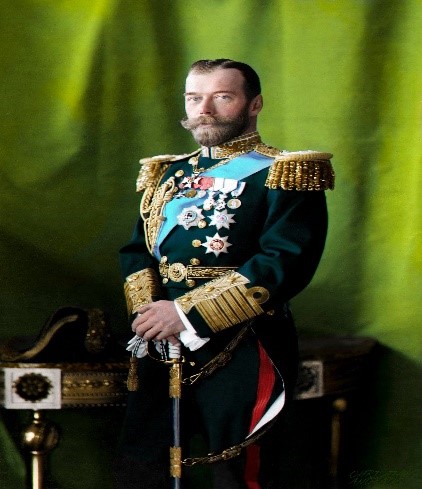
Tsar Nicholas II and Autocratic Rule in Russia. Tsars had ruled Russia since the 15th century and were considered divine right monarchs with unlimited power. Nicholas II inherited the throne in 1894 after his father, Alexanders II, passed.  Only 26, Nicholas II lacked his father’s vision, experience and fortitude.  Yet, the new Tsar believed he was entitled to rule as he wished and that his subjects were loyal to him even during widespread protest and dissent.  He preferred to blame dissension on “foreign elements,” particularly Jews, rather than address the underlying causes, such as poverty and poor working conditions. Like his father, Nicholas used his secret police and armed forces to suppress revolts.  However, this approach could not last as seismic social changes, encouraged by rapid economic growth, would increasingly challenge Tsarist rule. 

Tsar Nicholas II, Russia’s last Tsar from 1894-1917

Russia Industrializes. From the outside, Russia appeared to be an unstoppable power.  It possessed the world’s largest state territory, extending from Germany to China and Japan, and Europe’s largest population and army.  Russia also seemed set economically with abundant natural resources such as minerals and foodstuffs.  Culturally, Russia boasted the likes of Tolstoy, Dostoevsky, and Tchaikovsky as leaders in their respective arts. However, in many ways, Russia lagged behind European powers like England and France. The Crimean War (1854-56), which saw Russia lose to English and French expeditionary forces with superior navies and better weapons, highlighted Russia’s “backwardness.”

The loss inspired Russia to focus on industrialization.  Infused with foreign capital, Russia experienced large-scale industry growth as shops and largescale factories created products like textiles, printed materials and metalworks. By 1900, Russia had become the fourth largest steel producer and “turned out half of the world’s oil.” (Duiker, 15) Towns and cities like Moscow and St. Petersburg grew as they attracted people from the countryside seeking factory work.   Economic growth also required dependable transport. In the 1870s, Russia began developing an extensive rail network that facilitated the development of Russia’s mineral sector and the export of its grains to Western markets.  The vast Trans-Siberian railway linked Moscow to potential markets of the Far East – China, Manchuria, Korea and Japan.

Rapid Changes to Russian Society. Russia’s investment in industrialization and education fostered dramatic social changes destabilizing the regime. Industrialization led to increasing urbanization as more people moved to urban centres for work and school.  This urban migration altered class demographics, bolstering the numbers of industrial workers, commercial and industrial capitalists and the professional middle classes, including doctors, lawyers, and merchants.  State-sponsored basic education facilitated a rapid rise in literacy as universities arose in cities like Moscow and St. Petersburg. Historian Orlando Figes writes that “Between 1860 and 1914, the number of university students in Russia grew from 5000 to 69000.”(Figes, PT, 163)

Russia also experienced significant rural changes.  Serfdom ended in 1861, liberating serfs from the authority of manor lords from the noble class, but it did not drastically improve their plight. The new peasant class still laboured the land and now paid rent to the aristocracy through labour or money. Some still faced hunger and poverty with unpredictable growing seasons and minimal resources to manage agricultural setbacks. However, some peasants fared well “either by improving the agricultural productivity or by diversifying into non-agricultural activities.” (Hoskings, 358) The nobility retained a high status, occupying the highest posts in the military and government administrations and still owned vast lands. However, the end of serfdom eroded noble privilege.  Moreover, the new urban classes that benefitted from industrialization and urbanization eroded the nobility’s status.

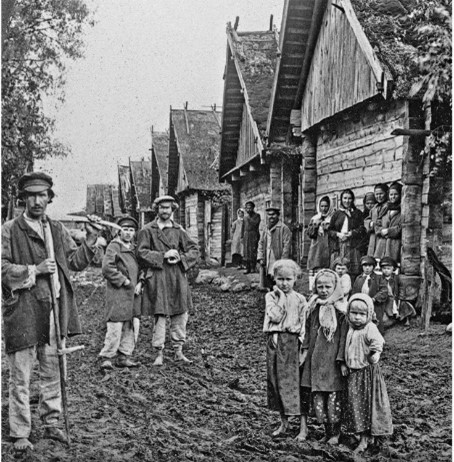
Russian peasants in a rural village circa 1900

The Limits of Tsardom. Events such as the Famine Crisis of 1891 highlighted the limits of Tsarist authority and a need for a less centralized political structure. The 1891 famine, made worse by cholera and typhus, killed half a million people by the end of 1892. (PT, Figes, 159)The Russian government could not provide adequate relief and needed to solicit help from private groups to facilitate relief efforts. District councils known as Zemstvos orchestrated the distribution of food and medicine.  Such demonstrations of Tsarist limitations and social change fed calls for political reform. For his part, Nicholas II dismissed these demands as stemming from foreigners, revolutionaries and Jews who needed to be vigorously repressed.

Widespread Discontent. However, the problems lay far beyond the Tsar’s short-sighted explanations. Industrial growth benefited some more than others. In the cities, the growing working class resented the obvious income disparities. As historian Margaret MacMillan writes, “The magnates in Moscow and St. Petersburg lived in magnificent mansions and assembled great collections of art and furniture while the workers lived in squalor and laboured long hours in appalling conditions.” (176) Workers also had few legal protections that offered job security or promoted physical safety. Unions were illegal until 1905, so there were few options to express their grievances as unions. With limited options, it is unsurprising that labour discontent was “widespread in Russia’s industrial center for at least the preceding two decades” before 1905 (Snow, 7).

Russian workers in a textile factory.

Workplace culture was also evolving. As historian Neil Faulkner points out,  workplaces bred “the more determined of the proletarian militants into a political revolution, creating a new kind of Russian intelligentsia, one formed of self-taught intellectuals.” (49).  Since the Tsarist government tended to side with the industrialists against workers, the latter saw autocracy as a barrier to a better life. 

Tensions also grew in the countryside. Peasants were officially emancipated in 1861, but their situations remained generally dire. Emancipation still favoured the landlord. Nobility, gentry, and prosperous farmers retained two-thirds of the land, including most pastures and woodland.” (38). Peasants could not sell the land allotted to them, raise money by mortgaging it or renounce their entitlement. Consequently, they had to pay a kind of tax for many years to claim the property they might not have wanted. (Boyd 48) To make matters worse, the landed nobility often raised land rent beyond affordability, so many peasants fell into arrears and worked extra to compensate.  The more desperate committed petty crimes and looted prosperous landowners. Famines in 1892, 1898, and 1901 worsened their plight and led to peasant uprisings or jacqueries.

Meanwhile, a growing middle class in the cities intensified their demands for a greater political voice.  There were no political parties or parliament to address their concerns or aspirations.  The Tsar had created district councils or zemstvos to administer his agenda, but they did not impact national policies.  The zemstvos’ active role in famine relief and the Tsarist regime’s inadequacies encouraged them to seek constitutional reform, including limits to Tsarist authority.  Not surprisingly, Nicholas II would saw many zemstvos as potential havens of insurrection and “subjected them to a relentless campaign of persecution.” (PT, 164) 

 A growing number of students actively protested against Tsarist rule and policies. Urbanization and increasing literacy created a growing student population acquainted with the anti-autocratic ideas of western thinkers such as John Locke and Karl Marx, and Russia saw an upsurge in radicalism in the universities of St. Petersberg, Moscow, Warsaw and Kyiv.  Nicholas further antagonized students when he passed a decree in July 1899 that lifted military deferments for students guilty of political misconduct.  Predictably, as McMeekin writes, “many students who protested the decree were impressed into the army.” (McMeekin, 20)  In July 1904, Plehve, the Minister of the Interior, was “blown to pieces by a bomb planted by the SR Combat organization. 

Social Revolutionaries. Some Russians didn’t believe reforms went far enough and called for a revolution to create their vision of a better society.  These included the Social Revolutionary Party, which focused on supporting the peasants – 80% of Russia’s population as the revolution engine. Social Democrats, on the other hand, focused on the urban working class or proletariat.  By 1903 the Social Democrats would splinter/divide into the Bolsheviks and Mensheviks. These groups played a more critical role in events leading to 1917 but did contribute to unrest in 1905.

The Russo-Japanese War 1903-1905.

Russia’s domestic problems were exacerbated by its foreign policy, particularly its efforts to expand into the Fat East.  Since 1860, when Tsar Alexander II founded a military base on the Pacific coast and dubbed it Vladivostok – meaning Lord of the East – Japan feared Russian encroachment and watched the construction of a Trans-Siberian mainland that couldtransport European arms on its borders (Boyd, 41).  Japan expressed its concerns to Russia, whose leaders saw the Japanese as an inferior non-European power impeding Russian growth and progress.

Japan decided to act. On February 8, Japan launched a surprise torpedo attack on the Russian naval squadron at Port Arthur. This pre-emptive attack occurred before Russia could send reinforcements for its Far Eastern forces. A series of defeats on land and sea would follow Russia’s initial setback.”(32 Fitzpatrick)   The Japanese forces proved more formidable, and Russia could not overcome the numerous logistical problems of fighting a war 6000 miles away. 

The defeat was humiliating and far-reaching.  Russia approached the peace table as the first European power to lose to an Asian foe in the imperialist era.  The war undermined Tsarist prestige and faith that Nicholas II could steer Russia in the right direction feeding the growing political unrest from all directions – students, workers, peasants, liberals and social revolutionaries.   An event in the first month of 1905 would spark widespread unrest and threaten to topple in Tsarist government.    

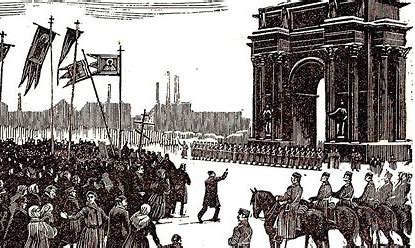
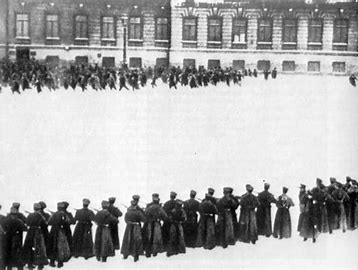
Bloody Sunday On Sunday, January 9, 1905, a crowd of almost 250,000 – workers and their families – approached the Tsar’s White Palace in St. Petersburg, intent on presenting Nicholas with a petition calling for political and economic reforms, including an eight-hour work day, the right to strike, civil liberties and a constituent assembly.   Unbeknownst to the protesters, the Tsar had already left the city.  As the unarmed peaceful protesters approached, Tsarist security forces panicked and fired on the crowd. More than a hundred protesters were killed or wounded in what became known as Bloody Sunday. 

Tsarist soldiers face protesters in front of the White Palace

The event triggered seismic outrage and sparked the 1905 revolution.  As William Duiker writes, it was a cataclysmic eruption of social disorder. (Duiker, 13).  Indeed, the event intensified dissent across Russia as “Wave upon wave of protest strikes rolled over the land….” (Lindemann, 159). Within a week, industrial workers across Russia were on strike. Revolutionary councils (soviets) sprang up in urban centers to help organize strikes that continued into the summer and the fall. Print workers protested in Moscow and St. Petersburg. Railroad workers went on strike a month later, paralyzing rail travel.  By the end of October, strikes had brought St. Petersburg “to its knees.” (Boyd, 58)  Revolts spread to the countryside with the 1905 Spring thaw peasants rose, refusing to pay rent, looting, seizing and burning estates.

However, these protests were generally disorganized. Tsarist forces readily quashed peasant uprisings village by village.  In the cities, they infiltrated and arrested organizers of worker strikes and student revolts.  As McMeekin writes, “So long as the army remained loyal, revolutionary schemes to topple the tsar remained little more than fanciful wish dreams.” (McMeekin 28)

Nonetheless, Russia’s government officials feared ongoing discontent that could eventually topple the regime and encouraged Nicholas II to make reforms. The Tsar resisted but finally conceded. Secretary of the Interior Witte publicly committed to drafting a proposal for a State Duma (Parliament), universal male suffrage, and fundamental civil liberties, including freedom of religion, assembly, speech, and association, to present to the Tsar for consideration.

The October Manifesto.  Nicholas agreed to what became known as the October Manifesto. The Manifesto legalized unions and political parties and established a nationally elected Parliament, the Duma. The Manifesto offered no solution to worker grievances, such as the eight-hour workday, respectful treatment by the employer, and better pay and conditions. (Figes, 33)  It would not be until the Tsar’s decrees of March 4, 1906, led to the legalization of strikes and worker’s unions.  For the peasantry, Tsar eased the peasantry’s redemption payments.

 Despite its limitations, the Manifesto was initially well received, with people celebrating the proclamation in the streets.” (Figes, 32)  However, this euphoria would be short-lived.  Tsarist actions would soon dispel hopes that Russia was en route to becoming a constitutional monarchy.  Nicholas II agreed to sign the Manifesto to appease a growing revolt rather than any conviction that he should share political power. Moreover, the defeat of the revolution proved to him that the Russian monarchy could triumph over adversity, that it was destined to lead Russia out of a time of trouble… (Wortman, 216)

Convinced of his righteousness and perceived need to weed out bad Russia’s harmful elements, Nicholas II resumed his suppression of those involved in the uprisings.  In December 1905, Nicholas II ordered the leaders of the St. Petersburg soviets arrested and put on trial for armed rebellion.” (Lindemann, 159). By 1906, the Tsar had curtailed the power of the Duma and fell back on the army and bureaucracy to rule Russians.” (Duiker, 15)

Conclusion. The 1905 Russian Revolution presented Russia’s Tsardom with a historically unprecedented challenge to its authority.  Members of all classes – workers, middle-class liberals, students, and peasants – protested Russia’s political system.  To stave off his usurpation, Nicholas II agreed to sign the October Manifesto that established Russia’s first Duma (Parliament) and offered long-demanded concessions, including the right to strike, legalizing unions, etc. Tsar also retained power because he retained the loyalty of the Russian Army and state police that could repress uprisings in the city and countryside.  

While the Tsar survived 1905, it was on borrowed time.  Widespread discontent would not wane as various classes continued to struggle. Nicholas II’s unwillingness to make meaningful reforms that would include more Russians in the political process lent credibility to the social revolutionaries who insisted that revolution was the answer.  With the added strains of the Frist World War (1914-1918), Russia toppled the Tsarist regime and embarked on a new path that would change the course of Russian and global history.     

Bibliography.

Ascher, Abraham. The Russian Revolution: A Beginner’s Guide. London: Oneworld Publications, 2014.

Faulkner, Neil. “The Revolutionaries.” A People’s History of the Russian Revolution, Pluto Press, 2017, pp. 27–51. JSTOR, http://www.jstor.org/stable/j.ctt1k85dnw.9. Accessed 11 Jan. 2023.

Boyd, Douglas. Red October: The Revolution that Changed the World. Glouchester, The History Press, 2017.

Duiker, William J.  Twentieth-Century World History. Belmont, CA: Thomson Higher Education, 2007.

Figues, Orlando. Revolutionary Russia, 1891-1991: A History. New York: Metropolitan Books, 2014.

Fitzpatrick, Sheila. The Russian Revolution. Third Edition. New York: Oxford University Press, 2008

Hoskings, Geoffrey. Russia and Russians: A History. Boston: Harvard University Press, 2011

Hutchinson, John F. “Sovereignty as a Constitutional Issue in Imperial Russia, 1905-1915.” T. University of British Columbia, 1963.

Lindeman, Albert S. A History of Modern Europe From 1815 to the Present. West Sussex: Wiley-Blackwell, 2013. 

Lindert, Peter H., and Steven Nafziger. “Russian Inequality on the Eve of Revolution.” The Journal of Economic History, vol. 74, no. 3, 2014, pp. 767–98. JSTOR, http://www.jstor.org/stable/24550511. Accessed 12 Jan. 2023.

MacMillan, Margaret. The War that Ended Peace: The Road to 1914. Toronto: Penguin Canada Books, 2013

The Bay of Pigs Invasion (1961) 

In April 1961, an American-sponsored contingent of 1500 Cuban exiles landed at the Bay of Pigs, intent on overthrowing Cuban leader Fidel Castro.  The attempt failed miserably.  Most invaders were captured and imprisoned.  The invasion further undermined U.S.-Cuban relations and heightened Cold War tensions, particularly Soviet-American relations.  It also stands as a conspicuous blemish on President Kennedy’s presidency. 

Historian Andrew Preston calls it the “biggest failure of his [Kennedy’s]  Presidency.” (89). Other scholars like John Rasenberger refer to the invasion as the “fiasco.” (xvii). What compelled the United States to organize and sponsor such an invasion? How did Cuban-American relations deteriorate to the point where Washington would risk political humiliation and cold war conflict to depose Fidel Castro?

Cuba and the United States

Some background history of Cuban-American relations helps us contextualize the Bay of Pigs invasion.  Cuba, located 90 miles south of Florida, had been a Spanish colony coveted for its natural resources – particularly sugar.  In 1808, Spain refused U.S. President Thomas Jefferson’s offer to purchase.  However, Spain was a declining power, and as Spanish influence receded from the Americas during the 19th century, the U.S. became increasingly involved in Cuba’s sugar, fruit, and molasses production.” (7)  In 1898, the United States defeated Spain and annexed Cuba as a colony. 

Washington promoted a Cuban resource-based economy dependent on US investments and buyers and sponsored successive Cuban governments who supported its broader Latin American policies. This arrangement continued throughout the 1950s as successive Eisenhower administrations backed Fulgencio Batista, the Cuban leader from 1952-1958.  A dictator, Batista fostered domestic discontent through corruption and repressing political opposition. Americans continued to control Cuban finances, rail, electricity, and sugar, while many Cubans lived in poverty and lacked access to education, healthcare and decent incomes.  

Cuban people resented Batista’s pandering to American commercial interests while callously ignoring Cuban people’s welfare.  

The groundswell of discontent fed Fidel Castro’s revolution that overthrew Batista in 1959. The new leader “nationalized” the economy by imposing widespread government controls. Castro also “invested in housing, schools and public works.  Salaries were raised, electric rates were cut, and rents reduced by half.” (Rodriguez, 25)

These changes reflected Castro’s goal of replacing an American-controlled Cuba with an independent regime.  On May 17, 1959, Cuba implemented the Agrarian Reform Law, which drastically reduced American ownership of Cuban land.  As Christina Fisanick points out, Castro’s reforms reduced American-controlled land from over 2 million to 1,000 acres.” (8). A charismatic speaker, Castro publicly identified as a revolutionary nationalist taking Cuba from imperialist America and giving it back to the Cuban people.  His actions backed his words.

Washington Responds

Not surprisingly, Washington did not welcome Castro’s rise to power or nationalist policies. Castro presented unprecedented challenges, at least in Latin America.  Historian Louis A. Perez Jr. writes that the most immediate was “the Cuban leader’s unprecedented and unrelenting condemnation of the United States for nearly sixty years of deeds and misdeeds in Cuba.” (229).  Some state officials dismissed Castro’s vitriol as the ravings of a mad dictator, while others saw him as a motivated communist.  Most seemed to settle on the latter explanation and framed Castro’s victory as a “Cold War problem.” 

Cold War

Washington’s assessment of Cuba grew out of the Cold War that evolved after World War Two (1939-1945) and centred on a global conflict between communism and democracy.  This bipolar view saw the Soviet Union leading the communists against the American-led democratic powers in a battle for international dominance.  While this paradigm didn’t give due justice to the complexities of the global environment, it still informed foreign policy. 

In 1947, only two years after the end of World War Two, the United States established the Truman Doctrine, which committed the U.S. to assist any country threatened by Communism. Washington showed further commitment by adopting the policy of “containment” that would compel American intervention in places like Korea, Vietnam, and Cuba, to stave the spread of communism. 

For his part, Castro denied being part of a global communist movement.  However, he turned to Moscow for economic and political support as Cuban-American relations deteriorated. Cuba signed a trade agreement with the Soviet Union in February 1960, and Moscow agreed to exchange the oil for sugar no longer purchased by the US.   By January 1961, Cuba established formal diplomatic ties with Moscow and “in early January 1961; the US terminated formal diplomatic relations with Cuba.” (Rodriguez, 26)

Washington saw Castro’s ties with Moscow as a serious threat to American security goals in the Americas and the world. Washington officials feared that the Cuban revolution offered the rest of Latin America an example that could undermine American hegemony in the region.  Eisenhower’s domino analogy now seemed applicable to Latin America. In a broader sense, Castro’s presence and aggressive reforms undermined American status at home and abroad.    As Perez Jr. writes, “if the United States could not contain the expansion of communism 90 miles from its shores, how could it be expected to resist communism in Europe, Asia, and Africa?” (239)

It can be argued that the American isolation of Castro and its history of exploiting the island and its people encouraged a nationalist revolution and an alliance with Moscow.  Some Americans acknowledged these factors, but regional security and Cold War priorities would prevail.  

Washington Plans

In his 1996 book, Confessions of a Cold Warrior, former CIA Deputy Director Richard Bissell writes that “A Communist government in Cuba, ninety miles from the US mainland, was unacceptable.” (Bissell, 152) Accordingly, American officials grappled with how to undermine Castro’s influence and, ultimately, oust him from power.  Some options were untenable. Washington dismissed calls for an open American military invasion of Cuba.  Such an overt act would escalate Soviet-American tensions and undermine Washington’s image as a promoter of freedom and self-determination. 

Instead, Washington chose political isolation, economic sanctions and covert sabotage.  As already mentioned, Washington set about isolating Castro diplomatically and economically by severing diplomatic relations and imposing a trade embargo on Cuba.  Besides these public tactics, President Eisenhower ordered the newfound Central Intelligence Agency (CIA) to create a covert plan to invade Cuba by arming, training, and transporting anti-Castro exiles. Historian Raul Rodriguez writes that if all went to plan, “the invading exiles would be greeted as heroes when they landed” and “all private sector assets would be returned,” as a US friendly replaced an ousted Castro. (Rodriguez, 26).  

However, Eisenhower would not remain in power long enough to see the plan through. His second presidential term was coming to an end, so it would be up to his Vice-President Richard Nixon to win the upcoming election and deal with the Cuba problem.   In Nixon’s way stood a formidable political challenger.

John F. Kennedy. (1961-1963)

The 1960 U.S. presidential election saw Republican Richard Nixon pitted against up-and-comer Democratic Senator John F. Kennedy, and Cuba was one of the election’s main issues.  Kennedy campaigned on a hard stance against communism and criticized the Eisenhower government for being “soft” on Cuba.  The Democratic candidate went so far as to publicly insist that Castro be removed.  As historian Howard Jones points out, Nixon had to “remain silent on the invasion plan and thereby unable to counter his adversary’s charge that the administration was soft on Castro.” (Jones, 36).

Kennedy won the election and was inaugurated in 1961. He immediately set about making an impression as an action-oriented President.  By this time, Castro had been in power for a year and had implemented many changes to Cuba that Washington perceived as reflecting Communist ideals.  On January 28th, CIA Director Allen Dulles formally briefed Kennedy and his senior advisors, warning that “Castro was converting Cuba into a Communist state,” and detailed the American plan to topple Castro’s government. (Jones, 46)

Kennedy knew the plan held profound risks, and some of his senior advisors rigorously opposed it.  Chester Bowles and William Fulbright, for instance, both stressed “the invasion pitfalls,” including the potential impact on Soviet-American relations and Washington’s claim as a promoter of political self-determination. (Rasenberger, 394) However, a strong lobby of American officials wanted to follow through, and as historian Mark J. White points out, Kennedy’s campaign promises “delimited his policies as president.” (Fisanick, 10). Besides reneging on a campaign promise, White adds, “Cuba would have exposed him to Republican accusations of “softness” of communism.” (Fisanick, 10). In short, the new President’s public and private commitments to topple Castro compelled him forward.  Once he committed, a core challenge involved executing the invasion in a manner that disguised American involvement. 

Fallout.

The plan failed.  Most of the invading Cuban exiles were captured and imprisoned.  Some historians suggest that American air cover could have swayed the results, but Kennedy did not want to expose Washington’s involvement.  It didn’t work.  Despite the denials, the American government’s involvement was exposed.   Cuban-American relations continued to deteriorate as Soviet-Cuban ties strengthened.

Interestingly, the Bay of Pigs debacle did not deter Kennedy from Washington’s overarching Cold War agenda. After the invasion failed, President Kennedy reinforced the need to respond to communism.  As Rodriguez writes, “The lesson he drew from the Bay of Pigs was the need for escalated adventurism, not caution.” (Rodriguez, 27)

Historical Interpretations.

Historians continue to study the Bay of Pigs invasions to understand what happened and why.  Various interpretations abound, and new evidence offers opportunities for fresh insights.  Some scholars focus their criticism on the CIA, suggesting the agency pushed a misleading agenda on the President.  Others point to anti-communist fervour in Washington as the main culprit. In his excellent book, Brilliant Disaster: JFK, Castro, and America’s Doomed Invasion of Cuba’s Bay of Pigs (2011), John Rasenberger acknowledges Washington’s “nearly hysterical” approach to containing Communism while challenging claims that the CIA pulled the strings.   The Bay of Pigs, he writes, “was a collaboration of both Presidential administrations, numerous legislators and the CIA, who “either did know or should have known, what they were agreeing to.” (xv)

Recent scholarship pushes beyond the bounds of American foreign policy to explore the broader context of the Americas. Rodriquez and Trog, for instance, present the Cuban-American conflict as a “fundamental contradiction between Cuba’s revolutionary ferment in search of national realization and the US hegemonic quest for maintaining a status quo throughout the Western Hemisphere. (17)

The Bay of Pigs invasion fascinates us, and future studies will offer fresh and exciting insights. 

Bibliography

Bissell, Richard M. Reflections of a Cold Warrior: From Yalta to the Bay of Pigs. Neultaven, 1996.

Fisanick, Christina. Ed.   The Bay of Pigs.  Farmington Hills, MI: Greenhaven Press, 2004.

Friedman, Rebecca R. “Crisis Management at the Dead Center: The 1960-1961 Presidential Transition and the Bay of Pigs Fiasco.” Presidential Studies Quarterly, vol. 41, no. 2, 2011, pp. 307–33. JSTOR, http://www.jstor.org/stable/23884834. Accessed 22 Aug. 2022.

Gleijeses, Piero. “Ships in the Night: The CIA, the White House and the Bay of Pigs.” Journal of Latin American Studies, vol. 27, no. 1, 1995, pp. 1–42. JSTOR, http://www.jstor.org/stable/158201. Accessed 22 Aug. 2022.

Gott, Richard. Cuba: A New History. New Haven: Yale University Press, 2004.

Jones, Howard. Bay of Pigs.  New York: Oxford University Press, 2008.  

Oakes, James.   Of the People: A History of the United States Since 1865. New York: Oxford University Press, 2017.

Pérez Jr., Louis A. “Fear and Loathing of Fidel Castro: Sources of US Policy toward Cuba.” Journal of Latin American Studies, vol. 34, no. 2, 2002, pp. 227–54. JSTOR, http://www.jstor.org/stable/3875788. Accessed 22 Aug. 2022.

Preston, Andrew. “Kennedy, the Cold War, and the National Security State.” in Andrew Hoberek ed. The Cambridge Companion to John F. Kennedy. New York: Cambridge University Press, 2015. 89-102. 

Rasenberger, Jim.  Brilliant Disaster: JFK, Castro, and America’s Doomed Invasion of Cuba’s Bay of Pigs. New York: Scribner, 2011.

Rodríguez, Raul and Harry Targ. “US Foreign Policy towards Cuba: Historical Roots, Traditional Explanations and Alternative Perspectives.” International Journal of Cuban Studies, vol. 7, no. 1, 2015, pp. 16–37. JSTOR, https://doi.org/10.13169/intejcubastud.7.1.0016. Accessed 22 Aug. 2022.

Samson, Anna. “A History of the Soviet-Cuban Alliance (1960-1991).” Politeja, no. 10/2, 2008, pp. 89–108. JSTOR, http://www.jstor.org/stable/24919326. Accessed 22 Aug. 2022.

Stern, Sheldon M. The Week the World Stood: Inside the Secret Cuban Missile Crisis. Stanford: Stanford University Press, 2005.

The Origins of American Slavery

In 1619 twenty Africans landed in Jamestown, Virginia, a budding British colony of the Americas focused on the growing and exporting of tobacco. Tobacco plantations required labour and until 1700, white indentured servants, mainly from Britain, provided most of the work. But various factors would lead plantation owners to replace indentured servitude with slavery and by the American Revolution (1776), all the British colonies practiced permanent chattel slavery. How and why did this transition happen? 

Colonial Plantations and Labour. Historian Peter Kolchin writes, “Almost from the beginning, America was heavily dependent on coerced labour… (3) Before slavery, British colonists utilized two other sources of unfree labour – Native American slavery and Indentured Servants. Native American slavery comprised a relatively small portion of colonial workers. Historians point to various reasons for this. First, diseases had severely decimated the Native American population since Europeans arrived in the late 1400s. Estimates vary, but there is a growing consensus that between 70 and 90 percent of indigenous Americans (North, Central and South America) died from European-borne diseases such as smallpox and measles. A decimated population could not meet growing plantation labour demands.   Also, familiar with local environments, Native Americans could escape, survive, and rejoin their communities.  

Indentured Servitude. Indentured servitude provided a better option and became the primary source of unfree labour during the 17th century. The arrangement ostensibly met the needs of both the servant and plantation owner. Indentured servants often left England to escape poverty, persecution and political instability. Without resources to traverse the Atlantic, they “sold themselves into temporary slavery in exchange for free transatlantic transportation… (Kolkin, 8). A steady supply of indentured servants pre-empted the need to seek alternative sources of labour – including slavery. As Kolkin writes,

so long as a ready supply of indentured labor continued to exist, colonists saw little reason to go to the expense of importing large numbers of Africans, who, unlike English labourers, had to undergo prolonged adjustment to alien conditions – strange masters had unusual customs, spoke an unintelligible language before becoming productive members of the workforce. (11)

Various factors made slavery less viable during most of the 17th century. Slavery at this time involved more risk and expense. Especially during the early 17th century, plantation labourer life expectancy was low. James Oakes estimates that “90% of those who migrated to the Chesapeake in the seventeenth century came as servants, and half died before completing the term of service.” (68). Plantation working conditions were brutal, and workers had less protection than in England. As Oakes points out, “As long as life expectancy was low, it was generally more profitable for a planter to purchase an indentured servant for seven years than a slave for life.” (10) Also, the immense crossing distance from Africa to North America – much further than Africa to Brazil, for instance) led to high slave fatalities and reduced profitability. 

The Transition to Slavery.  An interplay of factors encouraged the transition from indentured servitude to slavery. First, colonial demand for labour began outpacing the labour supply of indentured servants. Virginia’s growing tobacco plantations required more work, and from the 1690s, Carolina evolved into a significant producer and exporter of labour-intensive crops, rice and indigo. (Black,88) Carolina planters would benefit from enslaved Africans already well-versed in rice production. 

Factors on the supply side also encouraged the transition to slavery. Kolchin points out that “at the same time that colonial demand for labor was surging, a sharp decrease occurred in the number of English migrants arriving in America under indenture.” (11) Various factors contributed to this decrease. The monarchy’s restoration in England facilitated “both political stabilization and an economic upturn” that encouraged labourers to stay in Europe. (Kolchin, 12). Also, less arduous opportunities in American colonies like New York and Pennsylvania attracted immigrants, effectively siphoning potential plantation labourers.  

Essentially, the indentured labour supply could not keep up with the growing demand for labour. Slavery became an increasingly viable choice. 

Slavery Becomes More Viable.  Various factors mitigated the high initial costs of slavery for wealthy planters who benefitted from slavery as a long-term investment. In the 1680s, England’s Royal African Company broke the Dutch monopoly on the slave trade, significantly reducing the cost of slave transport. Also, enslaved Africans proved very capable and resilient. Many had engaged in agricultural labour and, unlike Native Americans, had been exposed to European diseases, developing immune systems more adept to colonial life. 

Unlike indentured servants, Africans remained slaves for life. In 1662, Virginia made slavery a hereditary condition by declaring that “all children born in this country shall be held bond or free according to the conditions of the mother.” (Berkin, 70) In other words, permanent slave status passed from the mother to her children. This law drastically favoured plantation owners. As Kolchin writes, “…whereas in the seventeenth century the slave population failed to reproduce itself and had to be replenished in much the same way the servant population did, in the eighteenth century, it became a self-perpetuating labor force.” (13)

Native Americans and English indentured servants also presented higher flight risks from the brutal conditions of plantation labour. European indentured servants could leave and readily blend into other communities. Native Americans often knew the environment and could escape and even return to their people. On the other hand, enslaved Africans landed in a foreign setting that offered no friendly escape destinations. Moreover, due to skin colour, Africans fleeing a plantation were more visible and less able to blend into free communities. As Kolchin writes, “Racial distinction, in short, facilitated enslavement. (13).

Slave Codes. Plantation owners also benefitted from slave codes. As Carol Berkin points out, the “legal difference between black and white servants was vague until the 1660s. As previously mentioned, in 1662, Virginia legislated that all children of slave mothers inherited her slave status. Other colonies followed suit. Slave codes legally entrenched racial differences while imposing various restrictions such as banning enslaved people from holding meetings, owning property, getting married, possessing guns or inflammatory literature. 

Conclusion. The transition to slavery happened relatively quickly – less than one hundred years. The estimates vary, but according to James Oakes, the number of African or African-descended inhabitants of the mainland colonies” increased from 2920 in 1660 to more than 300, 000 a century later. (126).  By this time slavery had become the labour system of the Southern colonies and was legally recognized in the Northern colonies.  

Slavery had been firmly entrenched in American society by the middle of the 18th century.    

Bibliography.

Berkin, Carol. Making America. A History of the United States. Boston: Houghton Mifflin Company, 2001. 

Black, Jeremy. A Brief History of Slavery: A New Global History. London: Constable and Robinson, 2011.

Foner, Eric. Give Me Liberty: An American History. Volume 1. New York: W.W. Norton and Company, 2017

Hine, Darlene and William C. Hine.  African Americans: A Concise History. New Jersey: Pearson Education, Inc. 2014.

Kolchin, Peter. American Slavery. 1619-1877.  New York: Hill and Wang, 1993.

Oakes, James. Of the People. A History of the United States. Volume 1: To 1877. New York: Oxford University Press, 2017.

Origins of Monotheism and World History

World History devotes much attention to the world’s belief systems and religions that shaped our past. One integral theme is the development and impact of monotheist religions, particularly the “Abrahamic traditions” -Judaism, Christianity, and Islam. Polytheism (multiple gods) preceded these “One-God” religions that eventually came to predominance in much of the world. Historians, anthropologists, and archaeologists seek to understand how and why monotheism happened. Recent studies over the last thirty years suggest that the three monotheistic religions evolved slowly from various historical circumstances. This evolutionary view challenges the traditional idea of monotheism as revolutionary insights from the likes of Abraham, Jesus, and Muhammed.    

Polytheism

Polytheism predated monotheism and resided in the earliest civilizations, linking gods to various phenomena. Gods inhabited or controlled the forces of nature or more minute aspects of life. Historian Greg Woolf writes that Mesopotamians “recognized thousands of different divinities, each associated with a different aspect of the universal, from the sky and the sea to humbler implements such as the plow and the hoe – there was even a god of brick-moulds.” (Woolf, 84). Polytheistic deities possessed supernatural but not unlimited powers and displayed human foibles. Sumerian gods for instance, “ate, drank, lusted, quarrelled and intervened in earthly affairs.” (Woolf, 8). In the Greek pantheon, Zeus’s philandering evoked Hera’s jealousy, and various gods vied for power. Polytheistic systems also tended to be linked to localities – a stark contrast to the universal God espoused by later monotheistic traditions. 

Polytheism pervades most of human history, but at some point, monotheism evolved, espousing the belief that one uncreated, all-powerful, and all-knowing God created everything. How did monotheism evolve and grow? The answers remain elusive, but scholars generally began with Judaism. 

Judaism.

There is no other god besides me, a righteous God and a saviour; there is none besides me. Turn to me and be saved, all the ends of the earth. For I am God, and there is no other.” Isaiah 45: 21-3

The Old Testament of the Bible identifies Abraham (born.c.1800 BCE) as the first Hebrew and the first monotheist.   Abraham left Ur (Mesopotamia) and travelled west to Canaan (modern Israel) after God promised him a “land of milk and honey.” In Canaan, Abraham received the covenant from God on Mt. Sinai, the written and oral law established between God and the Jewish people. God, often referred to as Yahweh (by scholars but not believers), later led Moses and his chosen people out of enslavement in Egypt (an event known as the Exodus) and back to Canaan. In Canaan, Moses climbed to the top of Mount Sinai, and God gave him the Ten Commandments. The First Commandment specified, “You shall have no other gods before me.” However, some Israelites continued to worship other deities, but over time an increasing number established a covenant with the One God.

This God fundamentally differed from gods previous. Religious scholar Karen Armstrong writes, “Unlike the pagan deities, Yahweh was not in any of the forces of nature but a realm apart” (99). In other words, God transcended the limited role ascribed to geography or function (e.g. Ares, God of War). As Robert Wright writes, Yahweh “was Lord of nothing in particular and everything.” (100) 

Interestingly, recent scholarship suggests that forms of monotheism, such as that espoused by the Egyptian Pharoah Akhenaten (c. 1353-1335 BCE), predated Judaism but did not survive. On the other hand, Judaism demonstrated incredible resilience as it spread with Jewish merchants to various communities and trading centres in Europe and Southwest Asia. As Christine Hayes writes, “Judeans survived even after the more numerous and powerful people like the Sumerians and Babylon and Hittites and “carried with them new ideas, a sacred scripture, a set of tradition that would lay the foundations for the major religion of the western world: Judaism, Christianity, and Islam.” (2)

Almost 2000 years after Abraham left Ur, a Jewish prophet would inspire what eventually became the most widespread religion in history – Christianity. 

Christianity.

For although there may be so-called gods in heaven or on earth – as indeed there are many “gods” and many “lords” – yet for us there is one God. Paul, Corinthians. 8: 5-6.

Christianity evolved from the Jewish notion of a “messiah,” foretold in the Old Testament. Christians identify Jesus as the Messiah and the Son of God. Christ is the Greek word for messiah. This belief fundamentally differs from Judaism and Islam; both recognize Jesus as a prophet but not as a divinity.

A Jew born in or near Nazareth, Jesus continued the Jewish tradition of prophets who mediated the earthly world with the spiritual. A “charismatic faith healer,” Jesus offered his teaching in Roman-controlled Palestine and attracted devoted followers until Romans crucified him (around 29 BCE) – an event Christians believe was a sacrifice of God’s son for the sake of humanity. After his death, Jesus’s followers recorded his teachings in the Bible’s New Testament Gospels. Christian missionaries and merchants spread these teachings via a vast network of Roman roads and overseas trading routes. “Jesus groups” and prophets like St. Paul gain coverts by offering an inclusive religion that promised salvation through faith in Jesus.   Christianity, as Huston Smith points out, “sought converts more provocatively than Judaism and would rapidly spread over the following centuries.  

This rapid spread, as Karen Armstrong writes, “certainly would not have succeeded without the Roman Empire.” (106). Rome initially persecuted Christians, who they saw as an obscure Jewish cult, as disloyal to the emperor but legally recognized Christianity in 313 CE, allowing Christians to own property and worship freely. In 325 CE, Roman Emperor Constantine (c. 272-337 CE) organized the first ecumenical council of bishops of the Roman Empire ” to unify canons of doctrinal orthodoxy and define a common creed for the Church.” As Scott Vitkovic points out, this step offered the first uniform Christian doctrine” that would bind Christians and foster Christianity’s growth. (5) By 380 BCE, Christianity became the Roman Empire’s official religion, a status that allowed Christians a significant advantage over competing belief systems.

When the Roman Empire fell in 476 CE, the Christian Church filled the power vacuum, ostensibly providing political stability, social order, faith, and hope. The Pope became the spiritual and political leader of much of Europe. The Church established a hierarchy of regional bishops overseeing more local priests administer this growing influence.   Christianity continued to grow into the next millennium until 1054 when it split into the Western Roman Catholic and the Eastern Orthodox. A more profound split occurred with the Protestant Reformation, encouraged by Martin Luther in 1517. Numerous Christian denominations evolved, but scholars tend to identify three main groups – Orthodox, Protestant, and Roman Catholic. 

Christianity’s meteoric rise as a global religion would foreshadow the rapid rise of another monotheistic religion centuries after Christ’s death– Islam. 

Islam.

He is the One God; God, the Eternal, the Uncaused Cause of all being. Koran 112.

More than 500 years after the death of Jesus Christ came Muhammed (570-632), the prophet of Islam, who lived in Mecca, a commercial center in the interior of the Arabian Peninsula. Polytheism still predominated Arabic society, but by this time, Judaism and Christianity had developed well-established traditions and a growing influence. As historian Ira M. Lepidus points out, monotheistic religion was “introduced into Arabia by foreign influences: Jewish and Christian settlements” and “travelling preachers and merchants…” (19). Accordingly, by “the sixth century, monotheism had a certain vogue.” (19)

At 40, Muhammed experienced a series of revelations through Allah’s angel Gabriel. Through these revelations, he identified himself as the last in a line of prophets, including Abraham, Moses, and Jesus. Muhammed saw these revelations as the completion of Judaism and Christianity that had lost their way. According to Islam, Muhammed and all prophets possessed no divine qualities but were mere messengers of God. In this sense, Islam agrees with Judaism by denying Christ’s divinity as the Son of God and the Messiah. Muslims see the period before Muhammed, including the polytheist and monotheistic religions, as a period of ignorance. Islam, in short, is a pristine monotheism.    

When he died in 632 BCE, Karen Armstrong writes, Muhammed “had managed to bring nearly all the tribes of Arabia into a new united community, or ummah” – an incredible feat. (135). He did not leave any writings, but his successors recorded his teachings in the Qur’an (Koran). Two main groups, the Sunni and the Shiite, evolved from disputes over the rightful successors to Mohammed. By the end of the 7th century, despite divisions, Muhammed’s followers had conquered Armenia, Persia, Syria, Palestine, Isreal, North Africa, and Spain. Today, it stands as the world’s second-largest religion.    

How did monotheism happen? Traditional religion asserts that monotheism began before history and the creation, with God the uncreated and that God (or Allah) first revealed himself to Abraham. However, historical evidence suggests that monotheism did not begin with Abraham of Ur. Scholars of the Ancient Near East generally agree that monotheism grew out of various historical processes but dispute how this happened. Biblical scholar Yehezkeh Kaufman sees the Hebrew God as more revolutionary than evolutionary, rejecting monotheism as “an organic outgrowth of the religious milieu” of the Middle East. Instead, he sees “an original creation of the people of Israel…absolutely different from anything the pagan world ever knew.” (Wright, 100)

Kaufman published his works in the middle of the 20th century. Since then, new scripture analysis and archaeological finds seem to reveal a more evolutionary process. Regarding the more traditional view that identifies monotheism as early as Abraham, scholars such as Karen Armstrong suggest that “we tend to project our knowledge of late Jewish religion back onto these early historical personages.” (14). Evidence indicates that Abraham and other biblical figures – Isaac and Moses – likely recognized multiple gods. Ancient Hebrew scripture refers to many Gods before gradually focusing on one God – Yahweh. Initially, Yahweh faced competition from the gods such as Baal, Enlil, Mardele and Amon-Re. Over time the Hebrews came to regard Yahweh as the only God, thus laying the foundations for a monotheistic religion.  

While the precise reasons for this evolution to monotheism remain elusive, scholars suggest various reasons. Historian Ira M. Lapidus links the development of monotheism to a growing and increasingly connected Middle Eastern population that could see a larger world beyond their local experience. So, instead of a god for a small community, why not gods (and eventual God) for the vaster world? (19?) Lapidus suggests that these religions, Judaism (and later Christianity and Islam), offered salvation and a sense of universal order in an often-unstable world.     Scholar Reuven Firestone reinforces this view, suggesting that monotheism “removed the universe and all its people from the fractions and uncertain rule of often bickering deities and placed them under the grace of One Great God. (20). 

Besides monotheism’s appeal for some, scholars point to the persecution of polytheists, later labelled as “pagans.” The term “pagans,” writes Jonathan Kirsch, “is a word invented by early Christians to describe anyone who refused to recognize the One True God.” (19).   Some monotheistic believers actively sought to rid the world of pagans. In 529 BCE, for instance, the Roman Emperor Justinian closed the school of philosophy in Athens, what Karen Armstrong calls “the last bastion of intellectual paganism.” (125).   Some nine centuries later, the Renaissance would see the revival of classical Greek and Roman philosophical works in Europe.  

Exploring the reasons for the growth of monotheism requires more space than we have with this blog which outlines the origins of the three Abrahamic monotheistic religions – Judaism, Christianity, and Islam. All three claim to follow the only God, a claim that has led to many conflicts among monotheistic religions (e.g. The Crusades) and against “pagans”. Historical and archaeological evidence suggests that monotheism evolved very gradually after Abraham. The scholarship also presents evidence that even with their monotheistic foundations, these religions evolved much slower than we once believed. Scholars such as Karen Armstrong argue that Christianity, for instance, grew out of disparate Jesus groups and did not consolidate until centuries after the death of Jesus. 

What is certain is that these monotheistic religions profoundly impact our past and our present. Future blogs will further explore these belief systems and others such as Buddhism, Confucianism, and Hinduism. 

Bibliography.

Armstrong, Karen. A History of God. The 4,000-Year Quest of Judaism, Christianity, and Islam. New York: Alfred A. Knopf, Inc, 1993.  

Bauer, Susan Wise. The History of the Ancient World: From the Earliest Accounts to the Fall of Rome. W.W. Norton, 2007.

Bowker, David et al. World Religions: The Great Faiths explored and explained. New York: Penguin Random House, 2021.

Firestone, Reuven. “A Problem With Monotheism: Judaism, Christianity, and Islam in Dialogue and Dissent.” Heirs of Abraham: The Future of Muslim, Jewish and Christian Relations. New York: Orbis, 2005 20-54.

Hayes, Christine. Introduction to the Bible. New Haven: Yale University Press, 2012. 

Kagan, Neil ed. Concise History of the World. An Illustrated Timeline. Washington, D.C. National Geographic, 2006.

Kirsch, Jonathan. God Against the Gods: The History of the War between Monotheism and Polytheism. New York: Penguin Group, 2004.

Lapidus. Ira M.  A History of Islamic Societies. New York: Cambridge University Press, 1988.

Oxtoby, William M. and Alan G. Segal. A Concise Introduction to World Religions. Toronto: Oxford University Press, 2007.

Perry, Marvin. ed. Western Civilization: Ideas, Politics and Society. Volume II, From the 1600s. Sixth Edition. 2000. 

Rosenberg, David.   Abraham: The First Historical Biography. New York: Basic Books, 2006. 

Sayem, Md. “The Monotheistic Concept of Judaism and Islam in the Light of their Basic Creeds: A Comparative Analysis.” The Dhaka University Studies. June 2012. p. 127-137.

Smith, Huston. The World’s Religions. Our Great Wisdom Traditions. New York: HarperCollins Publishers, 1991

Vitkovic, Scott. (2018). The Similarities and Differences Between Abrahamic Religions. IJASOS- International E-journal of Advances in Social Sciences. 4. 2018, 455-462. 10.18769/ijasos.455673.

Woolf, Greg. Ancient Civilizations: The Illustrated Guide to Beliefs, Mythology, and Art. London: Duncan Baird Publishers, 2005. 

Wright, Robert. The Evolution of God. New York: Little Brown and Company, 2009.

China’s Cultural Revolution (1966-1976)

From 1966 to 1976, Communist leader Mao Zedong led a “Great Proletarian Cultural Revolution” that renewed the Chinese Revolution that Mao felt had lost its way. Mao and his followers drastically altered the country’s political, economic, and social structure.   Historian Paul Clark calls it “the biggest non-wartime, concentrated social upheaval in world history. (1). Rhoads Murphey and Kirsten Stapleton describe it as “perhaps the great cataclysm in world history, measured by the hundreds of millions of people in mass persecution and suffering. (377).

During this period, Mao used strong imagery to promote himself as the “father” of the people and China as the world’s communist leader. By 1976, and after Mao’s death, moderates like Deng began to guide the country down a different path that invited economic incentives, western technology, education, and industrialization.

The Great Leap Forward and Soviet “revisionism.” A series of events leading to 1966 undermined Mao’s position in the Chinese Communist Party. First, his “Great Leap Forward” (beginning in 1958) was a disaster. Proclaiming that China would exceed British industrial production, Mao abolished private ownership and established communes throughout China to focus on manufacturing and bring industrialization to China’s rural areas. These peoples’ communes lacked organization and adequate equipment, expertise, and resources to succeed. Peasant resistance, administrative problems and bad weather also lead to unproductive food production. As many as 30 million starved or died from malnutrition in what Murphy and Stapleton describe as the “worst famine in world history.” (376). The program undermined Mao’s credibility and opened more opportunities to the moderate elements of the Communist Party, such as Lin Shaoquoi, who wanted to invite foreign technology and reinstate profit incentives.

Foreign developments also undermined Mao’s status. Mao had “portrayed Soviet policy-makers as ‘capitalist roaders’ and as betrayers of Marxism for seeking to cooperate with the West. (Rossabi, 386) The subsequent break with Moscow led to increasing political isolation and the withdrawal of much-needed Soviet technical support and economic assistance. In short, Mao’s zealous ideology furthered China’s isolation.   

Mao “revives” the revolution. Mao Zedong lost his position as head of state but somehow remained the most powerful and popular leader of the Communist party. He wanted to renew a revolution he felt had lost its vision and integrity. He insisted that China would fall into the complacency and Westernization he believed was happening in the Soviet Union without drastic changes. The Chinese revolution needed a revival.

Persecution. Supported by ideologically driven Party members and youth movements, Mao set about to “cleanse” Chinese society by targeting those deemed enemies of the campaign. The list of enemies proved long, but Mao and his supporters began with moderate party members like Zhou Enlai and Deng Xiaoping (1904-1997). A Red Guard Student Brigade ridiculed and abused Mao’s political rivals such as Liu Shou (killed), Deng Xiaoping (imprisoned), and Zhou Enlai (driven to seclusion).  

Mao closed China’s schools and universities, labelling them as breeding grounds for rightist dissenters. Intellectuals, including writers, educators, and academics who criticized Party policies, were removed or detained, sentenced to forced manual labour or killed. Persecutors identified these targets as “rightists,” “enemies of the revolution,” or people of “bourgeoisie” inclination. In 1968, Zhou Enlai finally convinced Mao to bring in the army to suppress the Red Guards, many of whom felt betrayed by Mao, who had encouraged their radical actions. 

Mao’s Economic Revolution. Mao and his supporters altered the economy to reflect their ideological goals. They criticized Zhou Enlai and Deng Xiangping’s welcoming of foreign technology to grow the economy. Mao preferred to depend on labour rather than machinery and favoured the competence and dedication of the proletariat over capital investment in technology. In other words, China would achieve progress and prosperity through domestic efforts without foreign inspiration or assistance. Like the Great Leap Forward, rural communes produced mediocre and low-quality items such as iron, steel, and agricultural goods.  Once again, the economy faltered.

The Moderates Regain Power. By the 1970s, the revolution lost momentum, mainly under the weight of its extremism and archaic economic policies. The violence of the Red Guard and other groups had gone further than even Mao saw fit. People coveted stability. Not surprisingly, Mao’s economic policies did not revive the economy, and China seemed again immersed in a weakening economy inspired by ideology rather than practical guidance. 

The Cultural Revolution received its final blow when Mao died on September 9, 1976. Again, the moderates moved to consolidate control. One of the first steps was to purge the Gang of Four from the Party and sentence them to life imprisonment. Deng Xiaoping would lead the moderates to shift China away from Mao’s ideologically driven plan to a more pragmatic approach that blended modernization and capitalist ingenuity into the Party’s communist agenda.

In future blogs, we will take a closer look at various elements of the Cultural Revolution and the preceding Great Leap Forward. As always, feel welcome to contact us with ideas about future blog topics you would like to see.

Bibliography

Clark, Paul. The Chinese Cultural Revolution. New York: Cambridge University Press, 2008.

Dikoter, Frank. The Cultural Revolution: A People’s History, 1962-1976. New York: Bloomsbury Press, 2016.

MacFaquahar, Roderick and Michael Schoenhals.  Mao’s Last Revolution.  Cambridge, Massachusetts: Harvard University Press, 2006.

Murphey, Rhoads and Kristen Stapleton. A History of Asia. Eighth Edition, New York: Routledge, 2019.

Rossabi, Morris. A History of China. West Sussex, Blackwell Publishing, 2014.